

February 19, 2025
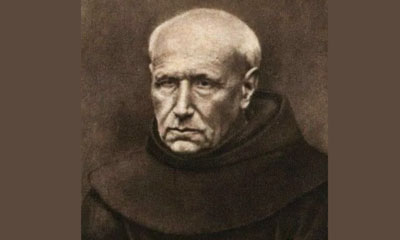
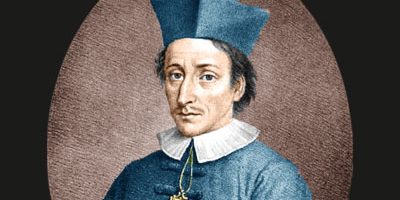
Blessed Niels Steensen
Dear Friends,
The day was June 24, 1666: Niels Steensen, a Danish Protestant scholar renowned for his work on anatomy, witnessed the Corpus Christi procession in Livorno, Italy. Seeing the reverent crowd paying homage to the Blessed Sacrament, he could not help but think: “Either this host is nothing more than a little piece of bread, and all those who adore it are fools, or it is truly the Body of Christ, and then why do I not honor Him too?” His reflections would lead him to embrace the Catholic faith. Pope John Paul II beatified him on October 23, 1988.
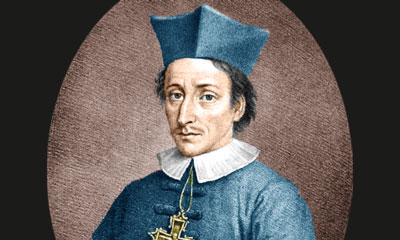 Niels Steensen was born on January 11, 1638, in Copenhagen, the capital of Denmark. In the world of medicine, he would become known under the Latinized form of his name, Nicolas Steno. He was the son of a goldsmith at the royal court, and descended from a family of Lutheran pastors. The hours spent in his father’s workshop as a child gave him the opportunity to develop his innate craftsmanship and his taste for science and technology; he measured the weight and volume of gold, built a microscope and studied the refraction of light. When he was ten years old, he attended the school of Our Lady where he studied the humanities, including Latin and Greek, mathematics and foreign languages, for which he was exceptionally gifted. Pope John Paul II said of him: “Niels Steensen’s entire life was an unflagging pilgrimage in search of the truth, both scientific and religious, convinced as he was that every discovery, however humble, constitutes a step towards absolute truth, towards that God on whom the whole universe depends” (Homily for his beatification, October 23, 1988).
In 1654–1655, Copenhagen was devastated by the plague, which killed a third of the population. “Please, Lord,” Niels would later pray, “may we always have these words before us: Memento mori—remember that you must die!” At the University of Copenhagen, he studied under a distinguished physician, Thomas Bartholin, against the difficult backdrop of a war opposing Denmark and Sweden from 1657 to 1659. In the autumn of 1659, his mentor advised him to continue his studies in Amsterdam, and then in Leiden, in the Netherlands, where material prosperity went hand in hand with cultural development. The great painter Rembrandt, a citizen of Leiden, was at the height of his artistic activity when Niels arrived there.
In March 1660, Niels arrived in Amsterdam, where anatomical research was in full progress. On April 7, he dissected a sheep’s head and discovered the duct which, in mammals, supplies the mouth with most of its saliva: it came to be known as “Stensen’s duct.” He modestly referred to it as a minor invention, yet it was to establish him as a famous scientist, familiar to doctors the world over. In July 1660, he enrolled at the University of Leiden; he discovered numerous glands and published a dozen research memoirs. Along with other renowned scientists, he studied the structure of muscles, blood vessels and the brain; he was the first to prove that the heart is a muscle. He established relations with Spinoza (1632–1677), a pantheistic, determinist philosopher whom he would later attempt to convince to join the Catholic faith—in vain. Upon his return to Copenhagen in March 1664, he presented King Frederick III with the results of his work in a memoir entitled “On Glands and Muscles” which was described by an 18th-century naturalist as a “little gold book.” In honor of his exceptional scholarship, the University of Leiden named him Doctor of Medicine in absentia, without requiring him to write a special thesis.
When he lost his mother in the summer of 1664, Steensen decided to further his studies in France, and arrived in Paris at the home of Melchisédech Thévenot (1620–1692), a well-known humanist and patron of the arts who often hosted scholarly meetings. These culminated in 1666 in the founding of the French “Académie des Sciences.” Niels performed dissections and delivered a speech on the anatomy of the brain that was to make profound impact. He also wrote dissertations on embryology, and became one of the pioneers of comparative anatomy, i.e. the comparison of a given organ in a number of different species. Steensen was fascinated by the beauty of creation (be it a precious stone or the human body), but he went beyond it, saying that “the true purpose of anatomy is to enable observers, by way of the masterpiece that is the body, to reach the dignity of the soul, and through the marvels of both, to attain the knowledge and love of their Author” (Opera Philosophica, t. II, p. 254). During his time in Paris, he met several people who played a part in his religious development, in particular a Jesuit Father, the Père de la Barre.
His Second Homeland
In the late summer of 1665, Niels traveled around France, visiting Montpellier, home to a particularly acclaimed medical faculty. Here, he made the acquaintance of eminent English naturalists, with whom he began studying geology. After arriving in Italy in the spring of 1666, he settled in Florence, where he worked with the most famous physicians. He would come to love this city as his second homeland. His anatomical studies drew the attention of the Grand Duke of Tuscany, Ferdinand II de’ Medici. He was appointed anatomist at the Hospital of Santa Maria Nuova, where he practiced and taught medicine. At the pinnacle of his scientific career, aged twenty-eight, he was elected to “l’Accademia del Cimento,” a college of scholars inspired by the work of Galileo. In Florence and then in Rome, he met a number of leading Catholic scientists, including the biologist Marcello Malpighi. Their discussions also focused on questions of faith and the relationship between faith and science.
“Faith and reason are like two wings on which the human spirit rises to the contemplation of truth; and God has placed in the human heart a desire to know the truth—in a word, to know himself—so that, by knowing and loving God, men and women may also come to the fullness of truth about themselves” (John Paul II, encyclical Fides et ratio, September 14, 1998, Introduction). The Catechism of the Catholic Church teaches: “Methodical research in all branches of knowledge, provided it is carried out in a truly scientific manner and does not override moral laws, can never conflict with the faith, because the things of the world and the things of faith derive from the same God. The humble and persevering investigator of the secrets of nature is being led, as it were, by the hand of God in spite of himself, for it is God, the conserver of all things, who made them what they are” (CCC, no. 159).
In the spring of 1667, Steensen published a memoir on “Elements of myology” (the study of muscles). He dissected the head of a shark and compared its teeth with those of fossilized sharks; he concluded that fossils were the remains of petrified living organisms, a novel idea at the time. In 1669, studying quartz crystals of different origins and shapes, he noted that their surfaces always formed the same angles between them. This discovery marked the beginning of modern crystallography. He described the phenomenon of sedimentation and articulated the notion of strata, and went on to demonstrate that it was possible to reconstruct the geological history of a region.
“I Would Give My Life”
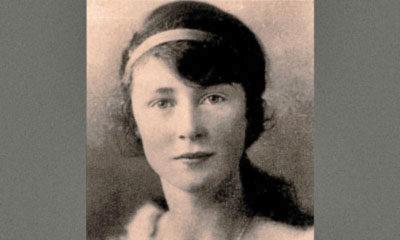
During his stay in Florence, already shaken by Bossuet’s eloquence in Paris, Niels Steensen began to read Catholic books and compare the various Christian denominations. With his scientific mind and love of precision, he turned to the study of theology in his quest for absolute certitudes. Two women of deep faith had a profound influence on him: one was his regular pharmacist in Florence, Sister Maria Flavia, a nun who had observed his unbelief and had taught him to pray for true faith. The other was Lavinia Cerami Adolfi, a diplomat’s wife with a forceful and yet gentle personality: with the help of her confessor, a learned Jesuit, she engaged Niels in spiritual conversations that encouraged him in his development. One day, when Steensen told her he failed to perceive sufficiently compelling reasons for him to abandon the religion of his ancestors, she replied with spirit: “If my blood could convince you that it is necessary, God knows I would give my life at this very moment for your salvation!” Eventually, his comparative theological study of Catholicism and Lutheranism, based on the writings of ancient authors, led him to conclude that the Catholic Church is the true Church of Christ. It was in Florence, in November 1667, that enlightened by a sudden grace, he fully embraced the Catholic faith and publicly abjured Lutheranism. On December 8, he was confirmed by the Apostolic Nuncio. In a letter to a friend, he ascribed his conversion to the way of life and thinking of the Catholics he had met on his early travels in the Netherlands, France and Italy, to their gentleness and charity, and to the long conversations about religion that had forged a bond of friendship between them and himself.
“Having overcome all doubts and darkness, filled with inner joy, Steensen pronounced his ‘yes’ to that which God had given him to understand clearly,” Pope John Paul II would say in the homily for his beatification. The Second Vatican Council states: “God Himself has made known to mankind the way in which men are to serve Him, and thus be saved in Christ and come to blessedness. We believe that this one true religion subsists in the Catholic and Apostolic Church, to which the Lord Jesus committed the duty of spreading it abroad among all men. Thus He spoke to the Apostles: ‘Go, therefore, and make disciples of all nations, baptizing them in the name of the Father and of the Son and of the Holy Spirit, teaching them to observe all things whatsoever I have enjoined upon you’ (Matt. 28:19-20). On their part, all men are bound to seek the truth, especially in what concerns God and His Church, and to embrace the truth they come to know, and to hold fast to it” (Declaration Dignitatis humanæ, no. 1).
An Unsettled Situation
Niels travelled to Amsterdam in the spring of 1670, there reuniting with scholars of his acquaintance with whom he discussed scientific and religious topics. These encounters prompted him to devote his life to bringing other believers back to the Catholic faith. In 1672, at the invitation of the king who desired his return, he moved back to Denmark to live with his sister, whose husband had taken over their father’s goldsmith’s workshop. He obtained a position as royal anatomist, but soon realized that the local authorities were not prepared to grant him favorable working conditions. As a Catholic, he was mistrusted, and his situation remained unsettled. Without prospects in Protestant Denmark, he left Copenhagen on July 14, 1674, for Italy. His journey led him to stop in Hanover, where Duke John Frederick, a Catholic convert, asked him to perform an anatomical study. He carried out several dissections in front of the court to demonstrate blood circulation and reveal the structure of the heart. He engaged in religious conversations with the courtiers and preachers of the city at the Duke’s table. He arrived in Florence in late 1674, where he was entrusted with the education of the twelve-year-old prince, the future Ferdinand III, to whom he taught not only the natural sciences, but also the religious and moral duties of life.
Eight years after his conversion, at the close of a long spiritual journey and having completed advanced theological studies, he was ordained a priest in Florence in 1675. Pope John Paul II would say of him: “He was the great scientist who recognized God as supreme Lord, consenting to follow his inner call to give himself totally to Christ and to put his energies exclusively at the service of the Gospel. And so it was that Steensen, not content with the apostolic commitment of a layman, desired to become a priest, in the certainty that this would not represent a divide in his life and itinerary, but rather a step forward towards a fuller life, a gift of himself for the good of mankind” (Beatification homily). Later, when asked why he became a priest, Niels would respond: “When I try to form some idea of God’s goodness to me—and this I will never be able to do to the full—I discover it to be so great that it impels me to offer Him the best I have, and the best I can. Knowing also the dignity of the priest, who every day at the altar presents his thanksgiving for the blessings he has received, his atonement for the sins he has committed, and every offering that can be pleasing to God, I have sought and been granted the favor of being able to present to the Eternal Father, for myself and for others, the pure and immaculate offering.” Niels’ spiritual approach of gratitude and self-offering is similar to that of Saint Ignatius in his famous prayer: “Take, Lord, and receive all my liberty, my memory, my understanding, and my entire will, all that I have and possess. Thou hast given all to me. To Thee, O Lord, I return it!” (Spiritual Exercises, no. 234).
In his conversations with Duke Como III de’ Medici, Steensen stressed the connection between the Duke’s political life and the salvation of his soul. In particular, he urged him to give up the lavish lifestyle of his family and his court in order to reduce the tax burden on the people. He frequently preached on the relationship between faith and reason, and wrote extensively to refute the many criticisms leveled at him in scholarly circles in his own country, as well as in Germany and the Netherlands. The conversion of such an illustrious scholar had not gone unnoticed among them, and they felt it “did them a great disservice.” He continued his research into geology, which was helped by the presence of fossil-rich quarries in the vicinity of Florence.
The Explanation and Source of His Desire
In 1677, the Queen of Denmark conveyed to the Pope her brother the Duke of Hanover’s wish to have Niels Steensen as bishop. The Supreme Pontiff accepted his request—upon which the chosen one set off for Rome on foot as a poor pilgrim, begging for his daily bread, humbly to prepare for his episcopal consecration. Blessed Pope Innocent XI appointed the saintly Cardinal Gregory Barbarigo to consecrate him, and entrusted the new bishop with the care of Catholics in all the northern European countries that had turned Protestant. “Rich in love, and even in suffering,” said Pope John Paul II, “Bishop Steensen was passionate about the crucified Christ, the High Priest… His chosen coat of arms, a heart surmounted by a cross, clearly symbolizes and summarizes the profound orientation of his existence. He wanted to place his whole life at the service of the cross of Christ, in which he saw the supreme statement of God’s love for mankind… The deeply-held conviction that Christ is the light of the world, and that it is only by encountering him that man can benefit from the light of life, was the driving force behind Niels Steensen’s determination to spare no energy in proclaiming the Gospel. This is where his missionary desire finds its source and explanation” (ibid.).
In Hanover, Bishop Steensen met Leibniz (1646–1716), a mathematician and idealist philosopher who would later say of him: “He was a great anatomist, and well versed in the knowledge of nature, but regrettably abandoned his research, and, from being a great physicist, became a mediocre theologian.” Leibniz was a Protestant, but he was never able to accept divine Revelation as an indisputable historical fact.
In the 16th century, the Protestant Reformation had led to the virtual disappearance of the Catholic Church in vast territories, and the Holy See was forced to suppress all the dioceses in northern Germany and Scandinavia. All that remained were small groups of faithful Catholics. In 1667, the area was entrusted to a vicar apostolic (a bishop delegated by the Holy See). Bishop Steensen, the second to hold this office, worked in and around Hanover until 1680, preaching not only in German, but also in French and Italian, as the Catholics there were mostly foreigners. He comforted the small Catholic flock and engaged in dialogue with everyone, from Lutherans to scholars, even if they were unbelievers. His life was “a shining example of openness and dialogue” (Saint John Paul II, ibid..). It gave witness to the way in which, “through uprightness combined with distinction and tact, exemplary morals and holiness of life, we can and must establish those relationships that foster mutual understanding, love and unity” (ibid.). Pope Saint John XXIII said of Niels Steensen: “Having himself traveled the arduous road that led him to the heart of the Church of Jesus Christ, he suffered a genuine inner torment at the thought of the many souls—especially those of his countrymen—who were deprived of the full light of Revelation, and he burned with an ardent desire to lead them along his path of truth… This torment was the source of his indefatigable activity, which bore the two distinguishing traits of true sons of the Church: an unalterable attachment to all points of revealed doctrine, and great respect and affectionate charity towards those who do not share our convictions” (October 14, 1959).
Extreme Humbleness
The Grand Duke of Hanover died in 1679, and was succeeded by his brother, who was a Protestant. Despite the latter’s show of a degree of goodwill, Bishop Steensen no longer enjoyed the same freedom. He accepted a mission to Münster, in Westphalia, which soon evolved into a position as auxiliary bishop to the Prince-Bishop of Paderborn. As the latter’s health declined, Bishop Steensen often replaced him, and, out of humility, he used to travel on foot. His words brought true comfort to Catholics; he liked to compare himself to a doctor who must know each of his patients.. He “showed great dignity and extreme humbleness,” his chaplain later recalled. He also became a beggar to the prince-bishop on behalf of the faithful, many of whom were destitute. When the prince-bishop died in 1683, the chapter of canons opposed Bishop Steensen, who was to have succeeded him. Sensing that major financial interests were at the roots of this conflict, the prelate took the decision to stand down.
In 1684, Steensen gave up his active ministry and moved to Schwerin in Mecklenburg, in northern Germany, where he led an ascetic life and resumed his scientific work on the brain and nervous system. He dressed as a poor man and subsisted on bread and beer four days a week. He even sold his crozier and pastoral ring to help the poor, in gestures that were more edifying than any fine sermon. He regarded himself as a great sinner who must atone for his sins; but outwardly he was very cheerful. When he realized that he could no longer fulfill his mission in the Nordic countries, he decided to return to Italy. However, he fell ill with an intestinal disease that caused him great suffering. Before he died, he cried out to the Lord: “Jesus, be Thou my Savior! I will sing Thy mercy throughout eternity!” He died on November 26 (or December 5) 1686, in Schwerin. His body was taken to Florence and buried in the Basilica of San Lorenzo, close to the Medici family, his patrons.
In recognition of his remarkable virtue and piety, Saint John Paul II proclaimed him blessed: “The secret of his existence,” said the Pope, “lies entirely in this: while he is famous for the discoveries he made in the field of anatomy, what he shows us through his choice of life is far more important. Thanks to the ‘science of the heart,’ Niels Steensen discovered God, Creator of all that exists and Savior of the world, and became His passionate herald in the midst of his brothers and sisters” (ibid.). Let us ask Blessed Niels Steensen, whom the Catholic Church celebrates on December 5, to help us bear witness to the truth of God’s infinite goodness and love.