

April 30, 2025
Blessed Miguel Pro
Dear Friends,
Mexico City, 1927. A young man dressed in workman’s overalls is cycling along the streets on his way to work. What is his job? To hear confessions and distribute Holy Communion in secret to hundreds of people in their homes, because all forms of Catholic worship have been banned by the government. This “worker” is in reality a young Jesuit priest wearing disguise to foil the police. There has been a price on his head for the past six months. “What a waste of money,” quips Miguel Pro, not without irony.
 Miguel Agustín Pro was born on 13 January 1891, the third child of a family of eleven, in Guadalupe, a mining town in the state of Zacatecas in central Mexico. His parents, Miguel and Josefa, were devout Catholics. Young Miguel developed a spirited and attractive personality: his pious nature went hand in hand with his lightheartedness and sense of humor. When he was ten, his parents sent him to a leading school in Mexico. But stomach pains that would plague him for the rest of his life soon forced him to pursue his studies at home. By the age of fifteen, he was helping his father, a mining engineer, as a secretary. From time to time, he would go down into the mines and chat with the miners; he was an excellent mimic and was soon able to speak their language. Meanwhile, his mother decided to care for injured or sick miners, and Miguel happily accompanied her on her charitable rounds. The Pro family soon founded a small hospital, where three doctors offered to treat patients free of charge.
Miguel enjoyed chatting with his sisters’ friends. When he turned eighteen, he started to go out in the evenings, becoming worldly and neglecting his spiritual life. This distressed his mother greatly. One day, she asked him to take a tabernacle veil she had embroidered to the parish rectory. He hung back somewhat, but eventually consented to go. At the rectory, he met two Jesuit priests who were on their way to preach a mission in the neighborhood. “Hello, young man. Would you like to come with us?” Miguel let himself be convinced and followed the mission’s spiritual exercises for a week. He emerged a changed man, having recovered both piety and inner peace. In 1911, María de la Concepción, his favorite sister, entered a convent, causing havoc in the young man’s heart—not long before, another of his sisters had already followed the same path. But her example gave him food for thought. A few weeks later, he announced to his parents that he had resolved to become a Jesuit.
After his request was accepted by the provincial, Miguel entered the novitiate at El Llano (Michoacán) on 10 August 1911. He was twenty years old. He took the cassock just a few days later, on 15 August, feast of the Assumption of Mary. It was a humid place, and he contracted malaria. To help him regain his health, he was allowed to take walks, and fruit was added to his meals. A young novice would later say of him: “Brother Miguel’s conversation was humble and light-hearted; without ever being a bore, he managed to slip pious reflections into his rather comical remarks. He had a strong devotion to the Sacred Heart… What I admired in him was his spirit of sacrifice and his patience in the face of all the misery that befell us on account of the chaotic state of the country.” Father Pulido, master of novices, would similarly witness: “What I appreciated most about this novice was his cheerfulness and sense of humor. He was the ideal companion at recess and celebrations. However, there were two men in him: the jolly fellow at recess and a religious of exceptional depth.”
On 15 August 1913, Brother Miguel was admitted to take his first religious vows. Just as he was about to begin his philosophy studies, a revolution broke out. Ever since Mexico gained its independence in 1810, the country’s “Liberators” had made repeated attempts to reduce the social influence of the Church. In 1913, Venustiano Carranza seized power, with the support of anti-clerical elements in the army and of the Freemasons. Persecution of the Church immediately commenced: priests were arrested, churches desecrated and religious orders suppressed. The Jesuits from Llano were split into small groups and Brother Miguel was obliged to flee with one of them in August 1914, disguised as a peasant. He travelled across a country devastated by gangs of soldiers. Passing through Guadalajara, Miguel met his mother Josefa, who had no news of her husband and had been reduced to extreme poverty. Mrs. Pro, who now took in laundry to earn bread for her family, showed him a painting of the Sacred Heart, her only treasure. She told him: “My son, even if you see me begging for alms, follow your vocation. We do not know whether your father is alive or dead, but we remain with God our Father.”
Unflagging Good Spirits
After a 46-day journey, the Mexican Jesuits arrived in the United States and soon set sail for Spain, where they were to found suitable accommodation. From 1915 to 1918, Miguel studied philosophy in Granada. His companions of the time would not remember him for his intellectual prowess, but for his piety, his spirit of mortification and his unflagging good spirits. Sometimes, in the midst of the laughter that he had himself provoked, he could be seen suppressing a wince: he suffered from chronic stomach pains that he tried hard to hide so as not to be a burden. From 1918 to 1922, in keeping with the training curriculum of his order, Brother Pro taught in a school for children that the Jesuits had just opened in Nicaragua. The unfinished buildings afforded him but scant protection from the climate: his health declined and his superior did not appreciate him very much. Humility and trust in Divine Providence helped him to retain a positive view of things.
Miguel subsequently returned to Spain to study theology for two years near Barcelona. In the summer of 1924, he made his annual retreat at Manresa, where Saint Ignatius had received the inspiration for the Spiritual Exercises from the Blessed Virgin. From 1924 to 1926, he completed his studies at the scholasticate in Enghien, Belgium: 135 young Jesuits from thirteen nations were studying there. Miguel’s superiors noticed his natural talent for languages. In his second year, Miguel was given permission to visit the coal-mining district of Charleroi with a view to preaching the Gospel. He succeeded in talking with a group of socialist workers, and his witty repartees struck a chord with them. Despite his rather disappointing scholastic record and poor health, Miguel Pro was ordained a priest in Enghien on 31 August 1925 by a French bishop, on account of his piety and apostolic zeal. The young priest embarked on his fourth year of theology, but his health soon took a turn for the worse: he was diagnosed with a stomach ulcer and was admitted to hospital, where he underwent three operations. In February 1926, he received a telegram announcing the death of his mother. Josefa knew that her mission on this earth was over and she had offered her life to God for her son; she was convinced that the Lord Jesus had heard her.
Miguel’s health did not improve, however, and he was sent to a convalescent home run by Franciscan nuns in Hyères in the south of France. The doctor who treated him soon confidentially told the brother accompanying him: “He’s a hopeless case. You must inform your superiors. Nothing has been said to the patient.” Father Picard, who was in charge of the scholasticate, informed Miguel of his condition and told him: “Go back to Mexico to die in your own country.” On his departure, Father Picard gave Father Pro permission to make a short pilgrimage to Lourdes, where he would receive great graces: “What I felt there is not something I should write about, it was one of the happiest days… At nine o’clock, I said Mass… I spent an hour in the grotto, crying like a child. Now I depart, my soul full of consolation. For me, going to Lourdes meant meeting my heavenly Mother, talking to Her, asking Her; and I did meet Her, I did talk to Her, I did ask Her…” He embarked at Saint-Nazaire, no longer under any medical treatment.
Going Underground
On 7 July 1926, Miguel disembarked in Veracruz in his civilian disguise. Providence protected him: the customs office did not open his luggage, and the passport inspector did not check his papers. When he arrived in Mexico City, he presented himself to Father Provincial Luis Vega, who assigned him the capital as his missionary ground. Passing by his home, he learned that his brother Humberto, aged twenty-four, was in prison for resisting anti-religious laws. One hour later, Father Pro had already begun his ministry in a secluded house where the parish of Our Lady of Guadalupe, Queen of Peace now stands.
It was precisely when Miguel Pro arrived in Mexico City that the crisis in Church-State relations was at its peak. The president imposed by the army, Plutarco Elías Calles, a Freemason steeped in Marxist ideology, reinforced the anti-clerical provisions of the 1917 Constitution: the thirty-three articles of the Calles laws banned religious education from all schools, exiled foreign priests, abolished religious orders and nationalized Church property. Any kind of priestly apostolate or ministry was prohibited except in churches. Realizing that the conditions imposed by the new laws made it impossible to maintain any form of ministry, the Mexican bishops decided, with the approval of Pope Pius XI, to suspend all public worship in the country as of 31 July 1926. Before that fateful day, Father Pro was called up to administer the sacraments. From 5 a.m. to 11 a.m. and from 3 p.m. to 8 p.m., his confessional was besieged by penitents. A few days later, he wrote: “How was I able to resist? I the fragile one, I the delicate one, I the interesting guest of two European clinics…? All this proves completely beyond doubt that if the divine element, which only ever uses me as an instrument, had not intervened, all this would have been over a long time ago.”
On 31 July, the Sacred Species were consumed: from now on, every tabernacle in Mexico was empty. Deserted churches were desecrated by the soldiers. Mass was celebrated in secret. Father Pro inaugurated “Eucharistic stations” in houses where he went at an agreed time to administer Holy Communion: “I distribute Communion to two to three hundred faithful every day. This keeps me busy until eight o’clock in the morning, not counting the confessions I hear on Wednesday, Thursday and Friday afternoons.” He organized student circles to help their members acquire a better knowledge of their faith. He also ministered to employees and servants; challenging the social rejection by which they were marginalized, he provided help for single mothers and founded a center for the rehabilitation of prostitutes.
For Christ the King
In a bid to counter the persecution, the “League for the Defense of Religious Freedoms” called a shopping strike. Catholics stopped buying anything but the bare necessities and withdrew all their money from the banks. The strike caused an economic and financial crisis. The dictator, Calles, was equally concerned about the armed revolt of the Cristeros (the followers of Christ the King). These humble peasants had started an unequal war against the revolution, for freedom of worship and the social reign of Christ (whose urgency Pope Pius XI had just reiterated in 1925 by instituting the liturgical feast of Christ the King). Existing violent measures against priests were escalated, even to the point of murder; lay people found carrying anti-government leaflets were shot without trial.
Jesus Christ is King. He told Pilate: “You say that I am a king. For this I was born, and for this I have come into the world, to bear witness to the truth. Every one who is of the truth hears my voice” (Jn 18:37). Christ’s reign is the reign of truth: the truth about God, the truth about man and his eternal destiny. On 23 February 2002, Saint John Paul II made the following observation: “Towards the middle of the millennium that has just ended, a process of secularization began which sought to exclude God and Christianity from all expressions of human life. The ultimate result of this process was laicism and agnostic and atheistic secularism, i.e. the absolute and total exclusion of God and the natural moral law from every sphere of human life.”
The Catechism of the Catholic Church teaches: “The duty of offering God genuine worship concerns man both individually and socially. This is ‘the traditional Catholic teaching on the moral duty of individuals and societies toward the true religion and the one Church of Christ’ (cf. Vatican II, Declaration on Religious Liberty, no. 1)… Thus, the Church shows forth the kingship of Christ over all creation and in particular over human societies” (CCC no. 2105; cf. encyclicals Immortale Dei by Leo XIII and Quas Primas by Pius XI).
When human societies reject all truth, the result is totalitarianism. “The Church invites political authorities to measure their judgments and decisions against this inspired truth about God and man: ‘Societies not recognizing this vision or rejecting it in the name of their independence from God are brought to seek their criteria and goal in themselves or to borrow them from some ideology. Since they do not admit that one can defend an objective criterion of good and evil, they arrogate to themselves an explicit or implicit totalitarian power over man and his destiny, as history shows’” (CCC no. 2244).
On 31 October, in defiance to the government, 200,000 pilgrims flocked to the shrine of Our Lady of Guadalupe just outside Mexico City; Father Pro encouraged them to sing hymns to Christ the King at the top of their lungs. On First Friday of November 1926, he gave Holy Communion to 1,300 people. Describing his daily life, he humorously remarked that the greatest danger he faced was not the police, but, as a cyclist, “extremely daring” motorists. His cool-headedness enabled him to avoid capture on numerous occasions. He even spent a short time in prison without the police discovering his true identity.
The Best of Your Charity
At the beginning of 1927, Father Pro set up relief committees to help families who had become destitute because of their loyalty to the Catholic faith and as a consequence of the civil war. He coordinated the efforts of a dozen people in charge of collecting food supplies. He was often seen carrying large bags of food to the needy, while making do himself with a very frugal diet. He provided spiritual and material assistance to underground women’s religious communities. From his prison, he sent one of them all the money he had left, with a note: “Now is the time for you to shower the best of your charity on me.” Miguel also helped the families of Cristeros, although he did not associate himself with the armed movement. He considered that Catholics had the right and duty to defend their political rights, including the right to practice their religion publicly. Both in letters and messages, he expressed his desire for martyrdom: “How dearly do I yearn to be found worthy of suffering persecution for the Holy Name of Jesus… but may His will be done… How I long to fly off to Heaven with a single sweep of my wings, where I can play the guitar and sing with my guardian angel!”
In March, his superior ordered him to go into hiding and no longer to go out, as the police were actively searching for him. He remarked: “How difficult is this virtue of obedience! I believe that obedience is the best of sacrifices.” However, he argued with his superior that the situation was not all that dangerous, and that his health had improved considerably: “My stomach hardly remembers having had an operation.” Father Pro soon obtained permission to return to his clandestine apostolate and, ever in secret, preached numerous retreats based on the Spiritual Exercises of Saint Ignatius. He invented all sorts of disguises in order to move around in Mexico City: he was in turn a traveling musician, a laborer, a chauffeur, a miner, a dandy, a student. He wrote in his diary: “Such inner joy did it give me to bring peace to a broken working-class family! What joy to bring Communion to a 94-year-old man! What a joy to hear the confession of an Italian gardener under a tree, or to teach catechism to a Communist carpenter among the shavings and sawdust of his workshop!”
On 13 November 1927, four young Catholics threw a bomb at the car of General Obregón, Calles’ top minister. Following their failed attempt, the police determined that the car from which the bomb had been thrown had once belonged to one of Miguel Pro’s brothers. As a result of a woman’s indiscretion and the revelations of a frightened child, the investigators discovered the Jesuit’s hide-out. At 3 a.m. on 18 November, twenty armed soldiers, guns drawn, burst into the room where the three Pro brothers were sleeping. Father Pro said to his brothers: “Repent of your sins”; his voice steady, he pronounced the sacramental absolution, adding: “Let us offer our lives for our religion in Mexico and let us do it together, so that God may accept our sacrifice.”
“As an Example”
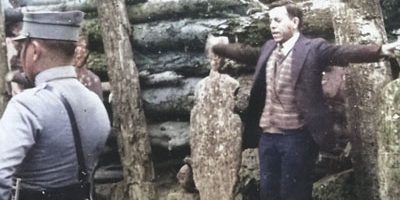
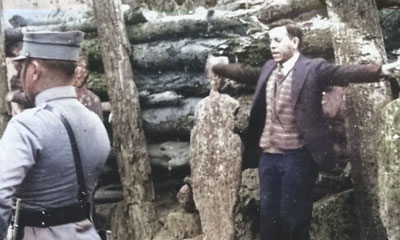
Miguel and his brother Roberto were taken to a damp, foul-smelling cell (Humberto was locked up elsewhere). During the five days of their detention, Father Pro and his fellow prisoners said their morning and evening prayers together, prayed the Rosary and sang hymns. Miguel engraved the following words on the wall of their cell: “Long live Christ the King! Long live Our Lady of Guadalupe!” When Segura Vilchis, the main organizer of the attack, learned that Father Pro was likely to be shot, he denounced himself to General Roberto Cruz, Inspector General of the Police, swearing that the Pro brothers had nothing to do with the bombing; they had not even known that it was being planned. Miguel and his two brothers had also sworn that they were innocent, and the police had no evidence. But Calles and Obregón ordered Cruz to have Father Pro executed “as an example”, without further formalities. At 10 a.m. on 23 November 1927, Miguel and Humberto were led to the execution post. Roberto would only be exiled because no charges had been brought against him. On the way, Father Pro pardoned his jailer and the soldiers. He was granted a moment to pray, which he did on his knees, with great devotion. Facing the firing squad, under the indifferent gaze of Cruz who was smoking a cigar, the young martyr stretched his arms out as on a cross and cried out: “Long live Christ the King!” As he was still breathing after being shot, a soldier delivered the coup de grâce. By having photographs of the execution published in the government press, Calles made Father Pro famous the world over. Much to the annoyance of the authorities, his funeral was attended by tens of thousands of people: it was a triumph. When the coffin was lowered into the Jesuit vault, Don Miguel, father of the young martyr, broke into a spontaneous rendition of the Te Deum.
Despite compromise agreements between the government and the Vatican in 1929, persecution of Catholics continued in Mexico up until the late 20th century. Among the many martyrs of the Mexican revolution, Father Pro, more than any other, has been venerated by the Catholic people as a symbol of the persecuted Church. On 25 September 1988, Miguel Agustín Pro was officially declared a martyr and beatified by Pope Saint John Paul II. His liturgical commemoration takes place on 23 November in the Society of Jesus and in Mexico.
Whatever the circumstances, we can associate ourselves with this prayer written by Blessed Miguel in his diary shortly before his death: “I believe, O Lord, but strengthen my faith… Heart of Jesus, I love Thee, but increase my love. Heart of Jesus, I trust in Thee, but give greater vigor to my confidence. Heart of Jesus, I give my heart to Thee, but so enclose it in Thee that it may never be separated from Thee. Heart of Jesus, I am all Thine, but take care of my promise so that I may be able to put it in practice even unto the complete sacrifice of my life.”