
November 26, 2025
Venerable Friar Ave Maria
Religious of the Sons of Divine Providence (Don Orione) (1900-1964)
Dear Friends,
Blessed are they that mourn: for they shall be comforted, says Our Lord Jesus Christ (Mt 5:4). This beatitude seems like a paradox. How can one be happy while suffering? The life of Cesare Pisano, whose religious name was Friar Ave Maria, shows that it is possible to be happy despite great trials—provided one seeks and finds God, as he did.
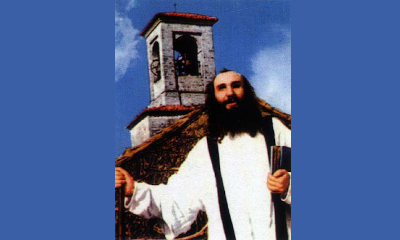 Cesare Pisano was born in Pogli di Ortovero, a small town in Liguria in northern Italy, on 24 February 1900. He was the eldest of the five children of hard-working Christian parents. His father, Cesare, a baker, emigrated alone to South America to offer his family a better life. The children’s education fell entirely to their mother, Serafina: she was a courageous, intelligent, and sensitive woman, who fulfilled her duty at the cost of many sacrifices. Cesare was raised to be pious and sober. Strong, lively, and intelligent, he did well in his studies, initially in the village, and later at the Sacred Heart Institute of Albenga. His future seemed bright.
On 1 November 1912, the feast of All Saints, Cesare’s grandfather spotted him with a group of rowdy boys and motioned for him to follow him to the cemetery to pray for the dead. But the boy pretended not to see him and went off to play in the nearby forest with his friend “Tumelin” (Bartolomeo) and a few other youngsters. They found a rifle in an open stable, and assumed it was unloaded. Whether out of curiosity, a taste for adventure, or sheer recklessness, they started a pretend war, happily swapping both rifle and roles. “Shoot, shoot, I’m not scared!” shouted Cesare, spreading his arms wide, preparing to “play dead.” Tumelin pulled the trigger… The buckshot struck Cesare in both eyes. He collapsed, screaming, “Mummy!”, as the game turned into a tragedy.
The injured youth was taken to hospital. The doctor had no choice but to remove his left eye. He said there was a slight hope that the right eye could be saved, but this would prove to be false. Many years later, Cesare recalled: “At the hospital, it was my brother who told me I had lost my eyes. Later the doctor told my father, who had traveled from America, that it would take a miracle for me to regain my sight. He said this right in front of me: I was desperate.” The love and affection surrounding him could not make up for his devastating loneliness. All his hopes for the future had been shattered. “Along with my sight, I gradually lost my peace of mind and my faith. I believed that this world was at the mercy of a fickle, cruel, and unjust higher power.”
When he was thirteen, Cesare was sent to the David Chiossone Institute in Genoa, which helped blind people overcome their disability. For him, this was the beginning of a time of crisis, marked by a deep distaste for life that bordered on despair. At school, he learned Braille, which allows the blind to read and write, but his efforts were half-hearted. He spent his days loafing around listlessly and found fault with everything. A spirit of rebellion grew within him against what he considered to be his “evil fate.” These dark thoughts destroyed his trust in God. Cesare no longer prayed, rejected the Church, and stopped attending Mass. Out of resentment, he denied the existence of God. For four years, he experienced a great spiritual emptiness. He would later admit to having been a great sinner: “I was ashamed of my physical and intellectual blindness, but I was not ashamed of being morally and spiritually blind.”
Cesare had already been blind for three years when a Daughter of Charity, Sister Teresa Chiapponi, arrived at the David Chiossone Institute as a nurse. This nun began to “hammer” at the heart of this rebellious young man with gentle acts of charity and simple but powerful words of faith. She helped him realize his spiritual and moral ruin. “Is it not enough that you are blind in your eyes, do you also want to grow up blind in your soul?”, she asked him. Cesare would remember: “When I considered this nun who was always busy with God and her neighbor, I thought, ‘Either she is crazy or she is a saint.’” In 1919, his grandmother died, and this event caused the young man to reflect on the meaning of life. One day, when Sister Teresa saw him overcome by melancholy, she said to him, “Why don’t you pray for your grandmother, whom you loved so much?” Cesare agreed; soon afterwards, he went to confession and received Holy Communion. The time of grace had come. A new companionship—that of God—gave meaning and purpose to his days of desolation. He began to pray of his own accord, alone and with others. He who had loved nothing for so long now loved being with God. Detached from and disenchanted with all creation, he realized that “God is everything.” He enthusiastically returned to his studies and learned various small trades that would prove useful to him later in life.
The Awakening of a Vocation
One day, Sister Teresa asked Cesare, “What are you going to do with your life?” He jokingly replied, “I’ll be a monk!” The nun said nothing, but prayed. A few days later, it was Cesare who asked her, seriously this time: “Sister Teresa, what do you think? Could I really give myself to the Lord?” “Yes, you can, and in fact you should. Think it over well.” She was thinking of Don Orione, a priest who was searching for a way to allow blind people to enter the religious life. Don Luigi Orione (1872–1940), canonized in 2004, was a priest from Piedmont who founded the “Little Work of Divine Providence” in 1903, an organization that responded in a flexible way to the spiritual needs of a wide variety of people: poor children, the sick, victims of natural disasters, etc. Sister Teresa had heard about the “Hermits of Divine Providence,” the organization’s contemplative branch. Could there be a place there for Cesare? She traveled to Tortona to meet Don Orione and asked him, somewhat anxiously, what the conditions were for a blind young man to be accepted into the novitiate. The priest replied: “One thing alone is absolutely necessary and indispensable—that he come to the door in person!”
From the moment he met Don Orione, Cesare was deeply moved by the passionate and practical way in which the priest spoke to him, with words that sprang from his boundless trust in divine Providence. The young man would write: “Don Orione made me want to seek eternal riches, true light, and divine wisdom. Despairing of earthly goods (oh fortunate despair!), my heart was filled with joyful and shining hope, certain that it is possible and easy to attain true happiness in the immortal life to which every human heart aspires and feels itself drawn.”
On 18 March 1920, Cesare arrived at the motherhouse of the “Little Work” in Tortona. There he recovered his passion for life, peace, and his air of serene joy that had once seemed forever lost. In July, he began his novitiate at Villa Moffa in Bra, in the province of Cuneo. The founder discerned in this novice an aptitude for the contemplative life centered on Eucharistic adoration. “During the night of the Feast of the Assumption in 1920, I had the grace of receiving the holy habit from the hands of my most venerable Father Don Luigi Orione, and, by God’s grace, this habit was so humble that it could have aroused the envy of the poor Seraph of Assisi (Saint Francis).”
Cesare spent a whole year at the “Paterno” (the general house) in Tortona. The following year, after taking part in the Spiritual Exercises, he moved to Bra. He attended primary and secondary school, learning Latin using Braille; prayer and work filled the rest of his day: “I cut wood for the kitchen… the sacristan calls me to help him… I also peel potatoes, pumpkins and turnips.” Like many blind people, he learned to compensate for his disability by using his other senses: hearing, touch, smell… He actively joined in building a large “Lourdes grotto” in the park: “I was lazy, as well as blind, and I had never done this kind of work, but for the love of Our Lady I started working with a pickaxe and a shovel, so that little by little, work became a pleasant thing for me, much more pleasant than play had been for me in my childhood.”
“Kicking This World Aside Once and for All”
In 1922, Cesare began his novitiate year, not without going through moments of inner struggle, during which Sister Teresa Chiapponi sent him letters full of valuable advice. He was well aware that without the accident that had left him blind, he would never have discovered God’s loving plan for him. In his great humility, he was overwhelmed by his past sins and needed all his trust in God’s mercy and Mary’s intercession to overcome his feelings of unworthiness. “When I think of what happened to me in such a short time, of my resolute decision to kick aside this corrupt and corrupting world—a world ruled by hatred, envy, slander, deceit, fraud, scandal, full of dangers and the source of all falsehood—once and for all, I must admit the truth: it was not I who chose the better part and who acted well, it was the Lord and the Madonna who chose everything and did everything in me.”
On 13 May 1923, Cesare climbed up to the hermitage of Sant’Alberto di Butrio, located in an isolated spot 700 meters (2,300 feet) above sea level in the Lombardy Apennines. There he found a small community set up two years earlier by Don Orione, consisting of a priest and three hermits. Delighted, he wrote: “In this little corner of paradise to which I have come, I was welcomed paternally, maternally, fraternally by four holy souls, living here in heroic charity! Everything is lacking here… No, on the contrary, nothing is lacking for those who want to become saints!” On 9 September 1923, feast of Saint Albert (the founder of the Abbey of Butrio around 1030), Don Orione vested Cesare with the hermit’s habit, white with two beige bands. He gave him a new name, Frate Ave Maria (Friar Hail Mary), saying to him: “I entrust you with one task, that of praying; pray always, pray for everyone.” Every day, the friar could be seen kneeling in church at four in the morning. His breathing was punctuated by incessant “Hail Mary’s.” He prayed several rosaries a day. People asked him, “Aren’t you tired of sitting like that, absorbed and kneeling?”—“You only get tired of doing what you don’t like,” he replied, adding: “When talking to the Lord, we begin by asking Him for what we want, but we always end up preferring His Will to our own.” His face, adorned with a long beard and flowing hair, made him look like a Desert Father.
His Winter Shirt
After only one year at the hermitage, a painful event marked Friar Ave Maria’s vocation. On the night of 6 November 1924, he coughed up blood, and this occurred repeatedly over the following days. The village doctor diagnosed advanced tuberculosis and told him he was dying. To the doctor’s great astonishment, the patient survived, but he remained frail and poorly. The cold winter weather in the unheated hermitage made him suffer greatly. “I am a poor blind man, not only in the company of Sister Blindness, but also afflicted with other ailments… with a weak, hoarse voice that is barely audible.” Coughing and loss of appetite were his “winter coat.” He commented: “These are the jewels the Lord has given me; would I be foolish enough to reject them? Perhaps these jewels will accompany me until my death; I have no right to prefer others!” In the 1930s, there were seven hermits at Saint Albert. Some were blind, others could see.
By now, Friar Ave Maria held in his hands the threads with which he would weave his life: outwardly, the hermitage, his community, prayer, penance, work, and menial tasks; inwardly, the experience of his own misery and of Divine Providence, the light of faith, charity, intimacy with God and the Madonna, and the confident awaiting of Heaven. Friar Ave Maria’s first letters date back to 1924; over the years, they became more frequent. Before 1942, he used a Braille machine for the blind. From 1942 onwards, he had a standard Olivetti typewriter; he knew the layout of the keys by heart. All his letters have been collected and fill fourteen volumes.
Obedience works wonders. In the summer of 1928, the only well supplying the hermitage with water was almost dry. Don Orione had invited some fifty young clerics from the college in Tortona to go and spend a month’s vacation in this beautiful place. A passing priest strongly advised them, in the interests of caution and hygiene, to cancel the trip: what would become of these young men if they could not wash and only had muddy water to drink? Told of this by one of them who had gone down to Tortone (30 km / 19 miles away), Don Orione sent the messenger back with the following instructions: “Tell Friar Ave Maria, from me, to go to the edge of the well and to say three Our Fathers. God will bless his obedience.” The friar did not hesitate: he went to the well and recited the three Pater Nosters with great devotion. Then he threw the bucket into the well with a pulley. To everyone’s amazement, the bucket came up full of pure, fresh water. Water flowed abundantly throughout the clerics’ month-long vacation. The day after they left, the well was dry again. The humble friar attributed this miracle to Don Orione’s faith alone.
“Just Passing Through”
With the exception of two stays at the hermitages of Monte Soracte, near Rome (1952–1954) and of San Corrado di Noto, in Sicily (1954–1957), Brother Ave Maria would spend the rest of his life at the hermitage of Sant’Alberto di Butrio. Wherever he was, he led “a life of silence, contemplation, and prayer, in order the better to meditate on the eternal truths.” Don Orione often sent him people who were anxious, troubled, or “searching,” so that he could comfort them and encourage them to pray and abandon themselves to Providence. They were often people of high social standing: aristocrats, professors, scientists, writers… One day, a wealthy gentleman from Genoa arrived at the hermitage and entered the friar’s cell. He was surprised to see the poverty in which the monk lived. He asked him, “But where are your belongings?—And where are yours?—But I’m just passing through!—Well, so am I!”
In the 1940s, after Don Orione’s death, Friar Ave Maria became famous despite himself, and people flocked to see him on feast days to receive a word of encouragement from him; one word only because of the condition of his lungs. During World War II, he offered his sufferings, especially the hunger he endured in the hermitage, for his people who were beset by disasters. The hermitage gave shelter to many refugees, including persecuted Jews. After the war, Friar Ave Maria remarked: “Everyone talks about peace and freedom, but only God is free, and only those who do His Will enjoy the freedom of the children of God, which is an abundance of peace and joy in the Holy Spirit. Either man prays to God, or he grumbles.”
Friar Ave Maria was blessed with special graces and charisms, which he concealed beneath the appearance of a “normal” life. God spoke to him through inner locutions: “I hear a voice resonating in my heart, teaching me. A voice that speaks to me alone, and that begins with making me see my sins, then hate them with all my heart. Oh, what peace floods my soul every time I hear that voice!” He described his spiritual experience as follows: “It is the loving embrace of the Infinitely Great and the infinitely small.” People were struck by the ease with which he was able to rise from the natural to the supernatural. Speaking about the Mass, Friar Ave Maria said: “For us, the Mass is being present at Golgotha, with Mary and John. It is the same sacrifice. You could say it means being transported there, back through the centuries. To be there, on Calvary, where Jesus dies.”
On this subject, Saint John Paul II wrote: “When the Church celebrates the Eucharist, the memorial of her Lord’s death and resurrection, this central event of salvation becomes really present and ‘the work of our redemption is carried out.’ This sacrifice is so decisive for the salvation of the human race that Jesus Christ offered it and returned to the Father only after He had left us a means of sharing in it as if we had been present there. Each member of the faithful can thus take part in it and inexhaustibly gain its fruits. This is the faith from which generations of Christians down the ages have lived. The Church’s Magisterium has constantly reaffirmed this faith with joyful gratitude for its inestimable gift. I wish once more to recall this truth and to join you, my dear brothers and sisters, in adoration before this mystery: a great mystery, a mystery of mercy. What more could Jesus have done for us? Truly, in the Eucharist, He shows us a love which goes ‘to the end,’ a love which knows no measure” (Encyclical Ecclesia de Eucharistia, 2003, no. 11).
The True “Good Death”
On All Saints’ Day in 1962, the fiftieth anniversary of his blindness, he stood before his fellow brothers and, paraphrasing Saint Paul, confessed: “Yes, blindness is a cross. But this cross is only temporary and very light, compared to the blessed and eternal light which is prepared for us” (cf. 2 Cor 4:17). Reflecting on his approaching death, Friar Ave Maria had written: “How sweet is death to those who spend their whole earthly life learning to die well! It is not death that is bitter; it is the actions we have done during this life that can make it bitter. But how well they die, too, those sinners who, between their sins and death, have known years of penitent life, of life lived in fear and love of God… Does it matter whether one dies young or old, poor or rich? What matters is to die well, to die a holy death. And to die a holy death, one must live a holy life, thinking often of death, always thinking, before anything one does: at the hour of my death, what will I be happy to have done?”
“Death is transformed by Christ. Jesus, the Son of God, also himself suffered the death that is part of the human condition. Yet, despite His anguish as He faced death, He accepted it in an act of complete and free submission to His Father’s will. The obedience of Jesus has transformed the curse of death into a blessing.” (Catechism of the Catholic Church, no. 1009).
In January 1964, Friar Ave Maria’s health deteriorated and his superiors sent him to the hospital in Voghera, which was run by the congregation. Despite the care he received, he declined rapidly. On the 20th, fully conscious, he joyfully received the Sacraments and whispered, “All is goodness and mercy from the Lord.” He expired on 21 January; his tomb is now in the church of the Hermitage of Saint Albert. On 18 December 1982, Saint John Paul II signed the decree proclaiming the heroic virtues of Friar Ave Maria. He is now “venerable,” pending the miracle that will allow him to be beatified.
“A happy man”: this is how Friar Ave Maria described himself: “This is a miracle performed by the Lord and the Madonna: a blind man, a great sinner, forgiven by God, dressed in penitential robes, a recluse within the four walls of a hermitage, this blind man is happy: happy enough to have compassion for the rich, the powerful, and the wise of this world who have neither faith nor love of God. This happy blind man prays to God and his heavenly Mother that the number of these wretched people may be as small as possible.”