

March 26, 2025
Saint Philippine Duchesne
Dear Friends,
“Nowadays the call to conversion which missionaries address to non-Christians is put into question or passed over in silence. It is seen as an act of ‘proselytizing’; it is claimed that it is enough to help people to become more human or more faithful to their own religion, that it is enough to build communities capable of working for justice, freedom, peace and solidarity. What is overlooked is that every person has the right to hear the ‘Good News’ of the God who reveals and gives himself in Christ, so that each one can live out in its fullness his or her proper calling,” wrote Pope Saint John Paul II in Redemptoris missio (7 December 1990, no. 46). With the canonization of Saint Rose-Philippine Duchesne on 3 July 1988, the same Pope presented the world with an example of missionary zeal. She was a saintly nun who contributed to the mission of the Church in North America in the 19th century.
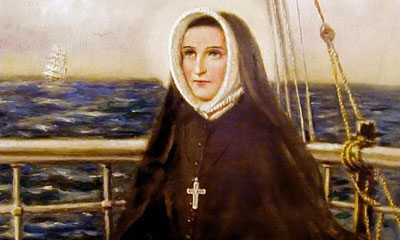 Rose-Philippine Duchesne was born in Grenoble on 29 August 1769. She was the daughter of Pierre-François Duchesne, a lawyer at the Parliament of the Dauphiné, a French province, and Rose-Euphrasine Perier. On her mother’s side, she belonged to a very wealthy family. When she was baptized, she was placed under the patronage of Saint Rose of Lima, the first saint of the Americas, and Saint Philip the Apostle. Even as a child, the little girl displayed the stiffness and determination of the Duchesne character, which she would strive to soften through persistent effort. However, she was also capable of forgetting herself in order to devote herself to others. In her own words: “My greatest pleasure is to do good to others!” Filled with yearning for all that is great and generous, she developed a high regard for the missions: “My first appreciation for the missionary state,” she wrote, “arose from the conversations of a good Jesuit Father who had served in the missions of Louisiana… I was only eight or ten years old, and yet I thought that missionaries were fortunate.”
Philippine was sent to a boarding school of the Sisters of the Visitation, a monastic order founded in 1610 by Saint Francis de Sales and Saint Jeanne de Chantal. Although the Sisters were cloistered nuns, they ran a number of girls’ schools. One of these schools, Sainte-Marie-d’en-Haut, was located in Grenoble. It was there that Faith took deep root in Philippine’s soul, and that the fear of God made her shun anything that might offend the divine gaze. The love of the Heart of Jesus impressed itself on her soul. Many of the paintings and inscriptions in the monastery reflect the powerful words of Saint Francis de Sales: “In God’s Holy Church, everything belongs to love, everything is founded on love, everything leads to love and everything is love.” God who made man in His own image and likeness, wants him, after His own example, to find in love the motive and mainspring of all he does.
Philippine made her First Holy Communion at the age of twelve. It was at that time that she heard the call to give herself entirely to Jesus in the religious life, and developed great fervor. “From then on,” her sister later recounted, “she saw the world only as a place of exile, and the religious life seemed to her the only thing capable of fulfilling the desire of her soul.” When her parents became aware of their daughter’s desire, they took her back into their home and introduced her to the mundane life; but amidst all the concerts and dances where she showed herself to be very much at ease, Philippine was thinking about fulfilling her vocation. At home, she looked after the beggars who came to the door, pursuing her studies all the while. In particular, she studied Latin with application in order the better to understand Sacred Scripture. By the time she was seventeen, she had turned down the offer of a lucrative marriage and renounced all worldly pursuits. A year later, in 1787, Philippine entered the convent of the Visitation despite her parents’ disapproval. Her desire to work someday as an educator of young people in boarding schools led her to prefer the Visitation to the Carmel she loved so much. She inspired her sisters through her unconditional love of Jesus and her vibrant charity. At the end of well-filled days, she would keep vigil in the evenings with the permission of her superiors, praying far into the night. On completing her novitiate, she was refused permission to take her religious vows by her father, who demanded that she wait until she was twenty-five; he did, however, allow her to remain in the convent. Following the advice of a wise priest, she obeyed him.
The French Revolution broke out in 1789, and in 1791 the Sisters of the Visitation of Grenoble were disbanded and their convent closed. Philippine returned to live with her family on a Duchesne estate in the department of the Drôme in the south of France. She dedicated herself to nursing prisoners and assisting refractory priests. When the revolutionary turmoil subsided in 1801, Philippine was asked to take care of abandoned or orphaned children, so she rented the former convent of Sainte-Marie-d’en-Haut; she moved in with a few children and invited the expelled nuns of the Visitation to return. Some of the former sisters did come back, but it proved impossible to re-establish the religious life. When she heard of Madeleine-Sophie Barat (1779–1865), who had founded the Society of the Sacred Heart in Amiens in 1802, she offered herself and her monastery to her. Madame Barat accepted and moved to Sainte-Marie in 1804 with three of her nuns. Following a brief novitiate, Philippine Duchesne took her first religious vows in 1805, at the age of thirty-six. As the Society of the Sacred Heart was dedicated to teaching, the convent of Sainte-Marie was converted into a boarding school.
A Night in the New World
In 1806, Dom Augustin de Lestrange, the Abbot of the Cistercian monastery of La Trappe, was invited to give a sermon to the community. Deeply impressed by the preacher’s description of the North American mission from which he had just returned, Philippine once again felt the call to join the mission. During the night of Eucharistic adoration on Holy Thursday, she received a special grace that she shared with Mother Barat: “I spent the entire night in the New World… carrying my treasure (the Blessed Sacrament) to all parts of the land… I had all my sacrifices to offer: a mother, sisters, family, my mountain! When you say to me, ‘Now I send you,’ I will respond quickly, ‘I go.’” For twelve years, Mother Sophie patiently molded her into an accomplished missionary nun. She encouraged her to be gentle: “You who love the good Francis de Sales so much,” she wrote her, “why did you not take some of his spirit when you were learning from him? He taught such gentleness with oneself and with everyone!” At the end of 1815, Philippine went to Paris for a general council of the Society. She was promoted to general secretary, and entrusted with the task of founding a community in the capital, in the Rue des Postes. In January 1817, Bishop Guillaume-Valentin Dubourg, the first bishop of Louisiana, presented himself there and asked for nuns to help educate young girls in his diocese (at the time, Louisiana was a vast territory stretching from the Great Lakes of North America to the Gulf of Mexico in the south, along the Mississippi River, which was over 2,000 miles / 3,700 km long). Philippine was ready to go.
A Pleasant Idea
In 1818, Mother Philippine, who had been appointed superior of all the houses that would be founded in America, went to Bordeaux with four nuns. They set sail for the New World on 21 March. After a grueling journey of seventy days marked by heavy storms, they arrived in New Orleans on the feast of the Sacred Heart. Mother Duchesne’s first move was to fall to her knees and kiss the ground, her eyes brimming with tears. After another forty-two days’ journey up the Mississippi in a paddle steamer, the five nuns finally arrived, some 600 miles (1,000 km) north, in St. Louis, a modest town of six thousand inhabitants founded by the French in 1764. Bishop Dubourg gave them a warm welcome. They then moved on to St. Charles, one of the two oldest towns west of the Mississippi, founded in 1765 only a few miles away. There, the Sisters opened the congregation’s first house outside Europe. It was no more than a log cabin, and the nuns were subjected to all the austerities of the pioneers’ life: bitter cold, hard work, lack of money, slow mail services between America and France. Mother Philippine also had great difficulty learning English. The institution had a dual function as a boarding school and a tuition-free school for poor girls. But shortages, hunger and a lack of students forced the nuns to close both the following year. “We used to have the pleasant idea of instructing the docile, innocent savage women, but laziness and drunkenness affect the women as much as the men,” Mother Philippine wistfully wrote.
The Catholic Church in the United States was not flourishing. Immigrants were often adventurers lacking in any moral sense. The Jesuits, who had been reinstated by Pope Pius VII in 1815, were rapidly gaining in importance, but limited themselves to founding boys’ colleges on the Atlantic coast. There were no educational establishments for girls. Slavery still existed throughout society, and the nuns, themselves unable to abolish this inhumane institution, employed slaves to do a variety of jobs. Yet, as the Second Vatican Council states, the Gospel “announces and proclaims the freedom of the sons of God, and repudiates all the bondage which ultimately results from sin, it has a sacred reverence for the dignity of conscience and its freedom of choice, constantly advises that all human talents be employed in God’s service and men’s, and, finally, commends all to the charity of all” (Gaudium et spes, no. 41).
At the invitation of Bishop Dubourg, Mother Duchesne and her nuns crossed the river and arrived in Florissant in the middle of winter. This community lies at the confluence of the Mississippi and Missouri rivers, and is reminiscent of a French village. The bishop had chosen to reside there to be closer to the Amerindian tribes. A farm was allotted to the Sisters. Soon students began to arrive. A chapel was built in time for Christmas 1819. Postulants joined the community, and Mother Philippine immediately opened a novitiate. She promoted the devotion to the Sacred Heart. Under her influence, the bishop dedicated the church he had built in Florissant to the Sacred Heart. Mother Sophie Barat had told her daughters on their departure for America: “If you were to raise just one altar to the Sacred Heart of Jesus in this country, that would be enough for the happiness of your eternity!” Conversions took place among the Algonquins and Osages; the Iroquois, who were under the influence of the English Protestants, were beyond reach.
Uncooperative Pupils
In 1821, a wealthy widow donated a large plot of land in Grand Coteau, near New Orleans. Mother Philippine travelled there and set up a boarding school for seventeen young girls. This foundation made it possible to take in the daughters of wealthy families of New Orleans. The Mother then returned to Florissant, where work was difficult because the pupils were uncooperative and not much inclined to regularity. In 1823, a group of eleven Belgian Jesuits arrived, including Father De Smet, who considered Mother Philippine to be “the greatest saint of Missouri and probably of all the American States.” Under the leadership of Father Van Quickenborne, these priests gave great impetus to the Missouri mission. Other missionary congregations, won over by Bishop Dubourg’s enthusiasm, such as the Lazarists, also settled in the region.
Believing or not believing in Jesus Christ is not the same thing. Whoever does not know the Lord is missing an essential truth. “Sometimes we lose our enthusiasm for mission because we forget that the Gospel responds to our deepest needs, since we were created for what the Gospel offers us,” Pope Francis wrote in his Exhortation Evangelii gaudium in 2013 (no. 265). Pope Saint John Paul II wrote: “The temptation today is to reduce Christianity to merely human wisdom, a pseudo-science of well-being. In our heavily secularized world a gradual secularization of salvation has taken place, so that people strive for the good of man, but man who is truncated, reduced to his merely horizontal dimension. We know, however, that Jesus came to bring integral salvation, one which embraces the whole person and all mankind, and opens up the wondrous prospect of divine filiation… Every human being needs Jesus Christ, who has conquered sin and death and reconciled mankind to God… The Church cannot fail to proclaim that Jesus came to reveal the face of God and to merit salvation for all humanity by his cross and resurrection” (Redemptoris missio, no. 11). For this reason, the proclamation of Christ by word and the testimony of life is the duty of all lay people (cf. Catechism of the Catholic Church, nos. 904-905). “There is no way to be a Christian without embracing the world in one’s ambition, without ardently desiring the day when Christ will gather all men under the invocation of his Name” (Father Lacordaire—1802–1861, Letter to a young man).
In 1826, Father Delacroix, pastor of a parish near New Orleans, appealed in his turn to Mother Duchesne to set up a foundation in St. Michel, not far from the big city. This was accomplished in conditions of great poverty and extraordinary trust in Divine Providence. In 1827, Mother Philippine took over an establishment of the Daughters of the Cross in Bayou Lafourche, not far from St. Michel, together with the house’s nine nuns and nine boarders.
A Painful Solitude
In the same year of 1827, a house was donated by the parish priest of St. Louis. Mother Philippine used it to open an orphanage, a boarding school and a day school. But Bishop Dubourg, Mother Philippine’s greatest ally, who had long been struggling with countless difficulties, beset bitterness and a victim of betrayal, returned to France, where he was appointed Bishop of Montauban. His departure was a painful blow for the Mother, and left her feeling very much alone: “Today, we have no other zealous friend than Jesus,” she wrote, “and any other support is languishing and drifting away from us.” In October 1828, in response to a request from the Jesuits, the St. Charles school was revived. Six houses now spread across the Mississippi Valley. Mother Philippine was reappointed superior of the houses of the Congregation of the Sacred Heart in Louisiana. She had reached the age of sixty, and her health frequently failed her. Moreover, she believed herself to be incapable. In the spring of 1829, she wrote to Mother Barat: “As for me, I’m nothing but a worn-out stick, ready to be thrown away at the first opportunity… Everything goes wrong in my hands. I see myself as an old lion with no means left to act, and whom everything overwhelms and stings.”
In 1834, she was in Florissant. Her many responsibilities did not prevent her from frequently spending the night with the sick. She also performed everyday tasks, such as mending clothes and tending to the barnyard and garden, though never neglecting religious instruction. Her young pupils agreed: “She made divine truths come alive and real for us.” But above all, she respected the precedence of the Divine Office. The moment she heard the bell announcing the Office, she would go to the chapel in calm recollection. The love she showed for her congregation was intense. At recreation, she would tell the young sisters about the beginnings of the institute and the works of the saintly Mother Madeleine-Sophie Barat in the heroic days in France.
In 1840, a new Superior General was appointed for the missions in America. Relieved of all responsibilities, Mother Philippine returned to St. Louis to devote more time to prayer. In 1841, she and three companions obtained permission to establish a foundation, as requested by Father De Smet, among the Potawatomis, an aboriginal people of the Upper Mississippi region who had been forcibly displaced to the west, and partially converted. Some objected, on account of Mother Philippine’s appalling state of health, but the Jesuit Father heading the mission insisted: “She may not be able to do much work, but she will assure success to the mission by praying for us. Her very presence will draw down all manner of heavenly favors on the work.” A hundred Indians on horseback gave the Mother an enthusiastic welcome. They made a guard of honor for her all the way to the home of the St. Mary’s Mission in Sugar Creek, founded in March 1839 by the Jesuits and comprising a school for the Potawatomis as well as a farm.
Amerindian Saints
“There are mestizos here who are saints. There are also saints among the ‘savages.’ In this mission we see what is not seen elsewhere, so reminiscent is the faith that reigns here of the early days of the Church… Once baptized, they never revert to drunkenness or stealing… The Potawatomis gather in groups for morning prayers, Mass, and catechism. In the evening they assemble again for prayers.” The local superior reported that on two occasions, the Sacred Host had escaped from the priest’s hands and placed itself of its own accord on the lips of a poor woman. Mother Duchesne observed that Christianity transformed not only the soul of the natives, but also their countenance. One Amerindian woman described how she had been instructed in religion by the Blessed Virgin herself, whom she often saw, and the sublime virtues of her life and death confirmed the honesty of her naive witness.. A good “Indian” had heard his guardian angel teach him the full story of Christ’s Passion. Soon, devotion to the Hearts of Jesus and Mary spread to the Flathead nation. But other tribes in the neighborhood were still subjected to the practice of cannibalism.
After the first moments of joy, however, evangelization proved difficult. Yet the Mother’s courage never waned, and her long hours of contemplative prayer led the Amerindians to call her “the woman who prays always.” “Lord, You alone are the Center in which I find rest. Give me Your arm to support me, Your shoulders to carry me, Your breast to lean upon, Your Cross to uphold me, Your Body to nourish me. In You, Lord, I sleep and rest in peace,” she would say to Jesus. However, she was forced to give up the idea of ever being able to make herself understood in the Indian language: “It is difficult and utterly barbaric. Endless words of eight or ten syllables, no dictionary, no grammar, no book… I don’t think I could ever learn such a language!” Her health did not long resist the harsh life and icy climate of the place, and in July 1842, she returned to St. Charles. There, her apostolate through prayer edified and encouraged her sisters and the pupils. The extraordinary graces she received in the Eucharist were outwardly manifest. She died at St. Charles around noon on 18 November 1852, murmuring the names of Jesus, Mary and Joseph. She was eighty-three years old.
“Today missionary activity still represents the greatest challenge for the Church,” wrote Pope Saint John Paul II. “It is clear that the peoples who have not yet received an initial proclamation of Christ constitute the majority of mankind… All who believe in Christ should feel, as an integral part of their faith, an apostolic concern to pass on to others its light and joy. This concern must become, as it were, a hunger and thirst to make the Lord known, given the vastness of the non-Christian world” (Encyclical Redemptoris missio, no. 40). The example of Saint Rose-Philippine Duchesne and her intercession before God will help us to proclaim Christ wherever the Lord has placed us.