

December 31, 2025
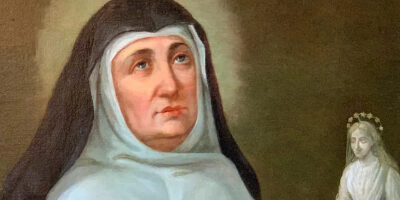
Saint Jeanne de Lestonnac
Mother of a family, widow, foundress (1556-1640)
Dear Friends,
Saint Jeanne de Lestonnac brought to light “the importance of the intellectual, natural, and supernatural education of women in view of their role in society during their normal lives as well as amid the struggles of the Church,” Pope Pius XII remarked on 17 May 1949, the day when this French nun was canonized. He observed: “She lived in a time marked by deep rifts, ruins and massive construction, a time of apostasy and miraculous conversions, of tremendous heresy and sublime holiness.”
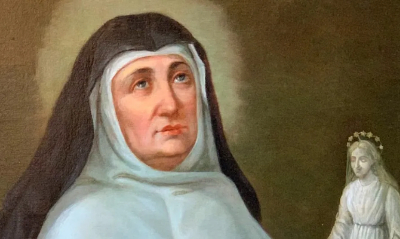 Jeanne de Lestonnac was born on 27 December 1556, in Bordeaux, to Richard de Lestonnac, a magistrate who always remained deeply attached to the Catholic faith, and Jeanne Eyquem de Montaigne, a staunch Calvinist who was the sister of the moralist Michel de Montaigne (1533–1592). Jeanne’s mother spent part of her childhood in Bordeaux, in a home “where life was hospitable and uncomplicated” (Montaigne, Essays); she received a thorough education, including a profound knowledge of Latin and Greek. Under the influence of her “Reformed” cousins, with whom her own parents unsuspectingly sent her to stay for long periods, Jeanne de Montaigne converted to Protestantism; her brother Michel remained in the Catholic Church.
In Bordeaux, where followers of both faiths lived side by side, bloodshed and murder were commonplace. Jeanne de Lestonnac’s mother sought to distance her from the Roman faith and assigned her a Calvinist tutoress—in vain. Yet Jeanne did not allow herself to harbor ill feelings against her mother and remained grateful to her. With the help of the Lord, she strove to preserve the purity of her faith, supported by her father’s piety and her uncle Michel’s zeal. Pope Pius XII said: “Let us imagine, if we can, the tragic rift at the heart of this household: a barrier divided the family into two opposing camps… And yet, everything—the gifts of the mind and heart, human virtues, harmony of character—seemed bound to make this home an ideal place of peace and joy. All, indeed, but one thing: unity in the true faith” (ibid.).
In the declaration Dominus Jesus of 6 August 2000, approved by Saint Pope John Paul II, the Congregation for the Doctrine of the Faith recalls: “the unicity of the Church founded by [Christ] must be firmly believed as a truth of Catholic faith. Just as there is one Christ, so there exists a single body of Christ, a single Bride of Christ: a single Catholic and apostolic Church… This Church, constituted and organized as a society in the present world, subsists in the Catholic Church, governed by the Successor of Peter and by the Bishops in communion with him” (No. 16).
Jeanne’s two sisters and three brothers all professed the Catholic faith. When she was about twelve, following an extended stay with Protestant friends where her mother had sent her, Jeanne joyfully returned to church, and the doubts that had momentarily assailed her were dispelled. It was then that she made her First Holy Communion. Hence Jesus would increasingly take the first place in her heart. One of her brothers, Roger, a student at the college recently opened in the city by the Jesuits, gave her his support. The tumult of the world, with its manifold violence and family conflict, caused the young girl much suffering, but she kept her calm because deep inside, the spirit of prayer was the crown of her spirit of faith. Michel de Montaigne greatly admired his niece: “Most pious, cheerful, intelligent, and beautiful, nature had fashioned her into a masterpiece… creating an alliance between such a beautiful soul and so beautiful a body, lodging a princess in a magnificent palace.”
In 1573, Jeanne’s parents introduced her to Baron Gaston de Montferrand-Landiras, of illustrious lineage. The wedding took place on 29 November. This put the young 17-year-old bride at the forefront of her mother’s society gatherings. But she saw through the false allure of the honors bestowed upon her and strove to remain in the shadows. Seven children would bless this union, the first two of whom died in infancy. Jeanne educated her children, awakening their minds and illuminating their souls. “Jeanne understood that it was necessary, whatever the cost, to restore life and unity of minds and hearts to the domestic hearth, but that this restoration could be achieved only through unity of faith in God and docility to the Roman Church, the one and immortal spouse of Christ… Her mission is poignantly relevant today” (Pius XII, ibid.). She also watched over her servants and their agricultural labors. She cared for the humble and became known as the “good lady.” “It is a great service to God,” she would later tell her nuns, “to accomplish in a timely manner all that He asks of us.” In 1585, Bordeaux was struck by the plague. But Jeanne feared the leprosy of the soul—sin—more than illness of the body, so she left her castle and went out to take care of the sick.
Forging Her Soul
In 1597, Jeanne lost her husband to a brief but fatal illness; a few weeks later, her eldest son, who was in his twentieth year, also died. The young widow was forty-one years old; two of her daughters would soon become nuns at the order of the Annunciation, and her other son married. Before long, only her youngest daughter, Jeannette, remained with her. As was customary at the time, she reverted to her maiden name and called herself Madame de Lestonnac. She devoted two hours each day to prayer and shared the rest of her time between her maternal duties and good works. She brought hope to all those who were suffering, and comfort to the miseries of both body and soul. However, she remained dissatisfied, and considered fulfilling her former desire to enter the religious life. “The probation she underwent in the secular life had forged her soul, expanding and maturing her experience,” Pius XII commented. “God’s call made itself heard anew, clearly and imperiously: to withdraw henceforth into the solitude of the cloister in order to save souls through prayer and suffering, more effectively than she could have done through her relationships and direct influence” (ibid.).
Jeanne used to attend the church of the Feuillants, served by Bernardine monks. During a visit by the provincial of this religious order, she opened her heart to him. He was impressed by the depth and strength of the young widow’s spiritual life, and suggested that she join the women’s branch of his order in Toulouse. Feeling drawn to this austere community, Jeanne waited until the eve of her departure in March 1603 to share her decision with her older children, so as to avoid the pain of prolonged goodbyes. She told her son: “Remember to lean mainly on God alone… Be careful to attract His grace by fulfilling all the duties of a Christian. I entrust your young sister to your friendship and prudence… Be a father to her with the wisdom of your advice. Farewell, my son, the voice of Heaven calls me to solitude, and I obey… In the retreat in which I will withdraw, I shall never cease to pray the Lord to shower you both with His dearest blessings.” François, having become the head of the family, was the natural guardian of his young sister, who was in her late teens. Jeanne was to board the boat that would take her down the Garonne River to Toulouse at the crack of dawn. But its departure was delayed, and Jeannette rushed to join her mother at the foot of the boat’s gangway. Her mother must gently free herself from her embrace: “Take comfort, I am not abandoning you. God will be your Father, trust in Him, your brother will be your protector, be obedient to him!”
“Be in My Heart!”
At the convent, Jeanne wholeheartedly embraced its ways and penances. Four months later, she joyfully received the novice’s habit and was given the name of Sister Jeanne of Saint-Bernard; God granted her many consolations. Nevertheless, she was unable to adjust, and her health failed. Her superiors sought to temper her. Jeanne was prepared to die at the convent, and begged to be allowed to stay. Following the advice of her council, the Mother Superior went to the infirmary and showed her the crucifix, saying, “You must resign yourself; God does not want you here.” This forced renunciation plunged her into spiritual darkness. She spent her last night at the convent in prayer, imploring the Lord: “I was unable to meet You in my youth, amid the turmoil of heresy, and I was unable to possess You fully in the pomp of the world. What a surprise, what an affliction for me not to find You, even in solitude!… Be in my heart, at least, the sole and lovable object of my hope. Remain there and make Your voice heard. And should I leave this house, may it be without ever leaving You!” No sooner had she finished her prayer than she was filled with consolation. She had a vision of a vast number of souls on the slope to hell, in danger of sinking into it if they were not rescued: she must lend them a helping hand. She conceived the idea of a female order that would devote itself to the education of girls under the protection and in the imitation of the Blessed Virgin. This order would atone for the insults that Protestants had inflicted on this Divine Mother. God showed her the greatness of this Queen, as well as the form of the institute she was to establish, where those who were not capable of bearing the austerities of the ancient orders could be admitted and find, in a rule with measured requirements, all the ways to high perfection.
In the morning, to her surprise, Mother Superior found Sister Jeanne de Saint-Bernard on her feet, a smile on her face. “Once again, God’s will had revealed itself to his servant; it did so through the voice of obedience… She was now ready for her great task: to give the world women who would know how to hold their own, women who would fight to maintain faith and fidelity to God and the Church in society” (Pius XII, ibid.). However, her return to the world was not understood: people ascribed her failure to presumption. Some of her children, delighted to be reunited with their mother, were triumphant! But she herself, abandoned to God’s will, remained silent. She arranged her life to include long periods of prayer and many charitable works. In 1604–1605, the city of Bordeaux was once again struck by the plague. All those who could fled; but Jeanne remained to care for the sick, to accompany the dying and bury the dead. Soon a small group of young girls blossomed at her side, eager to provide assistance. A deep friendship grew between them, marked by a desire to give themselves totally to God.
Simultaneous Inspirations
On 23 September 1605, two Jesuit Fathers named de Bordes and Raimond, were celebrating Mass at the same time when each was inspired to found a school for girls. In their surprise at having received the same inspiration simultaneously, they concluded that it must be of God. Together, they approached the Baroness de Lestonnac: “Can we count on you?” “As a collaborator, of course,” she replied, “but not as the founder of the school!” A few days later, while celebrating Mass, Father de Bordes had a vision of Saint Peter pointing to Jeanne who was praying in the chapel. After Mass, he described the apparition to her. She was shaken, but also delighted: if this was God’s will, she was ready!
She called together the nine young women who assisted her in her charitable works and presented them with the project. They responded with a ninefold and enthusiastic “yes.” Under the guidance of Father de Bordes, they followed the Spiritual Exercises of Saint Ignatius. On 7 March 1606, they presented a first draft of the constitutions of the future Institute to Cardinal de Sourdis, Archbishop of Bordeaux. On 25 March, the prelate gave his approval; that of Pope Paul V would come one year later, on 7 April 1607. “Against the heresy of her time, which fiercely sought to suppress Mary, Jeanne wanted to give Mary children full of love and devotion, and to give them Mary as their Mother. The new order would be that of the Sisters of the Company of Mary, dedicated to Her service and to the veneration of Her Immaculate Conception” (Pius XII, ibid.).
On 20 February 1608, Jeanne was granted the gift of a house, and at Easter, the archbishop established the new order. Some called Jeanne fickle, ambitious, and proud. In the new house, she took on the role of mistress of novices, that is, of all the other Sisters. Despite being attracted to corporal penances, which she practiced extensively herself, she taught the superiority of deeper sacrifices: “The sacrifice of the body is a small thing; we must make a more perfect sacrifice: resolving to leave ourselves behind.” She desired that humility become the distinctive trait of the Sisters. On Fridays, it was she who washed the dishes, and on Saturdays, she would wait at the table of the lay sisters.
As soon as circumstances permitted, the Sisters welcomed their first students. Their school was seen as providential, especially since the Calvinists had opened several schools in Bordeaux. Education would be free, so as not to confine it to wealthy families. The pupils were divided into four classes, where they learned to read and write, as well as basic arithmetic, sewing, and so on. However, religious education and piety were given precedence, not to mention the practice of charity. Joy reigned during the many breaks. Despite her ill health, the foundress particularly enjoyed teaching the pupils herself.
“All Is Not Lost!”
As early as 1609, King Henry IV’s approval favored the expansion of the new congregation. Already, in Bordeaux, there was an abundance of schoolgirls, and it soon became necessary to consider relocating. On 7 September 1610, the congregation moved into a larger building. But Cardinal de Sourdis had changed his mind! He wanted to dissolve the community and unite it with the Ursulines, another teaching order, so that Jeanne could bring them back to the observance of their somewhat neglected Rule. In her dismay, the foundress prayed with her novices: “Take heart, my Sisters,” she said, “all is not lost. We have never had any success that was not preceded by some disaster… Let us attach ourselves to God and remain closely united; that is all that depends on us. Heaven will do the rest!” Indeed, the Blessed Virgin intervened with the prelate, causing a complete reversal on his part, and on the following December 8, he received the first vows of the ten novices. Postulants presented themselves, enabling the first foundations to be established.
A planned foundation in Périgueux proved unsuccessful. However, another was established in Béziers in 1616, and later spread throughout the region. In July 1618, Poitiers followed suit. In 1620, there was another failure, this time in Toulouse… The Mother foundress went through a period of sorrowful bewilderment, yet her trust in God remained unshaken. A foundation was then established in Agen, where many postulants presented themselves. That same year, Father de Bordes died. Several other bereavements left the foundress in relative isolation. At this time, her two daughters, who were nuns of the order of the Annunciation, confronted with the laxity of their own congregation, applied for permission to join the order of Our Lady, which was granted by Rome.
In 1621, under the influence of Sister Blanche Hervé, one of the original Sisters, who resented the fact that she had not been given a position of responsibility by the foundress, the Archbishop of Bordeaux issued a violent and unjustified reprimand to Mother Jeanne, which undermined both her authority and the trust of her Sisters. The chapter, or community assembly, was held on 23 March 1622: as was the case every three years, the election of the superior was to take place. A group of young Sisters formed a faction against Jeanne, and Sister Blanche Hervé was elected. The foundress, then sixty-six years old, paid tribute to the new superior and thanked the Lord for relieving her of the burden of leadership. Before long, the new superior set about humiliating her and even went so far as to insult her, forbidding her from corresponding with anyone, or even from speaking with her companions.. She arranged for a list of Mother Jeanne’s alleged misdeeds to be read out in the refectory, while the foundress knelt in the middle of the room. But the Lord sustained Mother Jeanne: amidst the humiliation, she kept a calm face. “A nun must have a different kind of courage in the afflictions of life from that of ordinary Christians,” she told the Sisters who came to console her.. “The essential point of perfection consists in the victory we win over ourselves. We must carry the cross our whole life long.” The new superior, however, lacked the abilities called for by her position, and soon disorder and laxity infiltrated the community. Word of this situation eventually reached the ears of the cardinal, who asked Mother de Lestonnac, whom he still respected, to report to him. She wrote her report objectively, although she omitted anything that involved her personally. The report was given to the confessor, who handed it to Mother Hervé. The latter summoned the entire community and sternly reprimanded the foundress, forcing her to kiss the ground. “We will obtain a papal brief to remove the veil that you are so unworthy of wearing,” she told her. “And you will return to Landiras to tend the pigs!” Revolt began to stir among several Sisters, who were outraged by these proceedings, and the foundress worked energetically to calm them down. This situation lasted for almost three years. Finally, on 26 December 1624, perhaps through some illumination by the grace of Christmas, Mother Hervé asked the foundress for forgiveness: she was welcomed with open arms. At the following chapter on 23 March 1625, Mother de Lestonnac convinced the Sisters not to elect her; the office of superior went to Mother Anne de Badiff.
In 1626, Mother Jeanne, now seventy years old, was appointed to found a convent in Pau, a major stronghold of the Protestant heresy in France. A school was opened in the suburbs of the city, and pupils came flocking. Mother Jeanne taught the alphabet and the catechism to young children; she was often found with a broom in her hand. Ladies, and even priests, came to consult her. In 1630, famine spread throughout the Béarn. Mother Jeanne generously distributed food at the convent gate. When the famine ended, the convent’s provisions, surprisingly, were more abundant than before… In 1634, the war with Spain led to the closure of the house in Pau. It was a real heartbreak for the Mother. However, she heard the Lord promise her: “My daughter, in time, I will be served in this house with great zeal.” The school was in fact able to reopen the following year.
Worthy of Going to God
When she returned to Bordeaux, the foundress was often confined to her room: “I always have a slow fever… I constantly examine myself to make myself worthy of going to God.” Her prayers had become continuous. Three days before her death, a stroke deprived her of her senses. She regained them only to pronounce the names of Jesus and Mary. After a protracted agony, she died peacefully on 2 February 1640, the day on which the Sisters were renewing their vows at the Institute. By that time, the congregation had thirty communities. Saint Jeanne de Lestonnac is mentioned on 2 February in the Roman Martyrology. In 2017, the congregation had 1,352 sisters in 28 countries and 165 communities ranging from France to Japan.
“Today as then, heresy, and even more so irreligion, are attacking the Church, undermining the foundations of every society, the basis of the family, the principles of Christian, or even simply moral, instruction and education,” said Pope Pius XII. “Raise the young, then, in unwavering adherence of will, heart, and mind to the Church of Christ, in unalterable, filial, and firm devotion to the Virgin Mary, who has triumphed and will always triumph over all errors!” These powerful words urge us never to recoil from any sacrifice when what is at stake is to provide children with a Christian education. Let us beseech Saint Jeanne de Lestonnac to intercede for us! The need to be watchful over education is all the more important and compelling at a time when society is threatened by destructive ideologies (particularly gender ideology) and schemes that endanger the innocence of children from their earliest years.