
August 13, 2025
Blessed Conchita Cabrera de Armida
Dear Friends,
“I recommend that you always remain brave Christians… I beg of you that you pass on your faith to your children through your instruction and example, and that you spare no sacrifice to ensure that they receive a Christian education…” These lines were written by a Mexican woman, Blessed Conchita Cabrera de Armida, in the testament she composed for her children in 1928. Who was this mother who was so deeply concerned with the transmission of the faith?
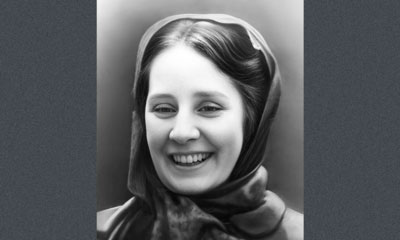 María Concepción Cabrera de Armida, affectionately known as Conchita, was born on 8 December 1862 to a well-to-do family in San Luis Potosí, in north-central Mexico.. Her parents owned vast estates divided into five haciendas (farms) and were deeply religious. “In the haciendas,” Conchita would later write, “my father would lead the recitation of the rosary every day in the chapel, surrounded by his entire family, the farm workers and the country folk.” The seventh of twelve children, Conchita only attended school for a short time. She would later admit, “My education remained very rudimentary because I was foolish and lazy, and also because of all the moving and traveling during my school years… When it came to running the house, my mother taught us everything I know: from washing the wooden floors to embroidery… She would never let us be idle… Moreover, she took care that we remained deeply humble so that we would not be carried away by vanity… From my earliest childhood, I felt in my soul a powerful inclination towards prayer, penance and, above all, purity.” During her long walks in the countryside, she would immerse herself in prolonged reflection and prayer, slowly meditating over the words of the prayers she had memorized, while contemplating nature. She also spent many hours playing the piano and singing.
She made her First Holy Communion on her tenth birthday. In her diary, she blamed herself for being frivolous, but little by little her devotion to the Eucharist grew, and by the age of sixteen she was receiving Communion every day: “It was an absolute necessity in my life.” Conchita was twenty-one when she became engaged to Francisco Armida. “I was never worried about courtship in the sense that it could have made me belong less to God. It was so easy for me to put the two things together,” she later wrote. The night before her wedding, she recited the fifteen mysteries of the Rosary. “At the wedding dinner (on 8 November 1884), it occurred to me to ask the man who was already my husband two things, both of which he promised to grant me: to allow me full freedom to receive Communion every day, and not to be jealous,” she wrote. She later confided: “My husband was ever a perfect model of respect and tenderness… My love for him never prevented me from loving God. I loved him with great simplicity, as if wholly enveloped in my love for Jesus.” But she also admitted, “When we got married, my husband had a really violent temper, he was like gunpowder; but as soon as the flare had vanished, he would stop, embarrassed. After a few years, he changed so much that even his mother and sisters were surprised..”
Conchita and her husband had nine children between 1885 and 1899. Her son Ignacio later recalled, “My mother viewed her marital relations with great simplicity… Of course, she insisted greatly on purity in our upbringing, but I have come to understand that she judged human things without seeing sin everywhere… Later, she spoke to me about my marital duties towards my wife. I realized then that her sense of purity was not ignorance.”
Family life was not always easy: “The Lord allowed me to experience many humiliations at the hands of my sisters-in-law,” wrote Conchita. “He allowed me to appear useless and unpleasant in their eyes. Try as I might, I never managed to please them… This crucible was very beneficial to me, even more so because my husband often agreed with them. This detached me from myself… When I spoke, although it cost me a great deal at first because of my pride, I always praised my sisters-in-law… My father-in-law loved me very much from the start… My mother-in-law later confessed to me that at the beginning of my marriage, she didn’t like me at all, but later she grew to love me very much.”
Anchored in Love
“Christian marriage and family life are only seen in all their beauty and attractiveness if they are anchored in the love of God, who created us in his own image, so that we might give him glory as icons of his love and holiness in the world’ said Pope Francis on 25 August 2018… God’s grace helps us every day to live with one heart and one soul. Even daughters-in-law and mothers-in-law! No one said this would be easy. You know that better than I… Each day Jesus warms us with his love and lets it penetrate our whole being. From the treasury of his Sacred Heart, he offers us the grace we need to heal our infirmities and to open our minds and hearts to hear, understand and forgive one another” (Dublin, Ireland).
Conchita’s first child was a boy, Pancho, born on 28 September 1885, followed by Carlos on 28 March 1887. She wrote about her mystical experiences and reflections in a journal that would ultimately fill 60,000 pages. Monsignor Luis María Martínez, who would become her spiritual director, and later Archbishop of Mexico City, once wrote to her: “I believe that you yourself cannot fully appreciate the riches contained in your diary… As long as I am your spiritual director, I will not allow you to destroy even a single letter.” In her writings, Conchita describes apparitions of Christ and the Holy Trinity, and shares messages from Jesus that focus on his Sacred Heart, the Trinity, Divine Mercy, the priesthood and the Eucharist.
In 1889, Conchita went on a retreat: she attended the teaching sessions, after which she would catch a few moments of silence and contemplation before rushing back home to take care of her family. It was then that she received an inspiration from the Holy Spirit: “One day, without a shadow of a doubt and to my great astonishment, I heard these words ringing clearly in the depths of my soul: ‘Your mission is to save souls.’” Another day, she heard: “You will block the entrance to hell for a great number of souls…” Indeed, eschatology features prominently in Conchita’s revelations: the beatific vision of God, which is the supreme goal of our life here on earth, but also the possibility of damnation through our own fault. Our Lord showed her hell so that she might realize what it really is: “Hell is above all a tremendous hatred against Me,” He told her. Following this retreat, Conchita went to her brother Octaviano’s house, where she gathered about sixty women to lead them in a number of spiritual exercises. The fire burning within her set their hearts ablaze. Yet she herself experienced great inner struggles; torn between the attractions of the world—she sometimes spent her time reading fashion magazines—and her desire for perfection. It was then that the Lord sent her a spiritual director, Father Alberto Mir, a Jesuit, who was a great help to her. She experienced profound grief when her second son, Carlos, died of typhoid fever at the age of six in March 1893.
“I Wish the Cross to Reign!”
With her spiritual director’s permission, Conchita engraved the monogram IHS (Jesus) on her chest. From then on, she wanted to resemble Christ on the Cross and quench His thirst for souls: “Union with the Cross must bring forth from the soul the most sublime and selfless love. This love is pure, unmixed with egoism or self-love.” One day, the Holy Spirit appeared to her in the form of a dove, hovering above a cross with, at its center, a heart surrounded by thorns. The Lord said to her: “The world is sinking into sensualism, and sacrifice is no longer loved, nor is its sweetness known. I wish the Cross to reign…” The Lord revealed to her that she must establish, for men and women, the “religious of the Cross,” whose apostolate was to carry forth and complement the message given by Saint Margaret Mary in the 17th century. Jesus told Conchita: this “consists in making known the interior sufferings of my Heart which are ignored, and which constitute for me a more painful Passion than that which my body underwent on Calvary.”
In September 1894, during another retreat according to the Spiritual Exercises of Saint Ignatius, Conchita made 42 resolutions to improve her relationships with her husband, her children and those close to her household. The following year, the family moved to Mexico City, where Conchita founded the Works of the Cross, which brought together lay people, priests and religious. Its only rule was for its members to offer themselves for the redemption of the sins of the world, identifying themselves with Christ on the Cross. In 1897, she founded the Congregation of the Sisters of the Sacred Heart of Jesus, contemplative religious dedicated to the adoration of the Blessed Sacrament and prayer for the sanctification of priests. These nuns also teach catechism and run houses for spiritual retreats (in 2017, the Congregation had 269 Sisters in 20 houses). This work aroused both enthusiastic support and hostility. In 1900, the Archbishop of Mexico ordered an investigation into the life and writings of the foundress. On 1 October of that year, Conchita wrote: “Today, following a thorough examination and after much prayer, Father Melé, the visitor of the Congregation of the Heart of Mary, assured me that my spirit was from God and that he was willing to bear witness to this.”
Conchita’s husband confided to her his fear at the thought of death. As he lay dying, he made a general confession, and his fear gave way to complete acceptance of God’s will. Conchita, who was anticipating his painful demise, wrote: “As I saw our separation approaching, the tenderness of my heart towards him grew ever greater. I felt that I no longer had a head nor faith nor reason, but only a heart.” On 17 September 1901, after seventeen years of marriage, Francisco Armida passed away. Conchita, now approaching the age of 39, would always carry the wound of his death in her soul. Reflecting on the past, she realized how intense, pure and holy her love for her husband had been. However, she also recognized many faults in her life as a wife and reproached herself for not having shared the secrets of her soul with her husband. On 3 February 1903, Conchita was introduced to the venerable Father Félix de Rougier (1859–1938), the superior of the Marist Fathers in Mexico City. She placed herself under his spiritual direction and revealed to him that he would be the founder of a new family of religious. The signs she gave him as proof of the divine origin of her message were such that Father Félix believed her at once. Acting prudently, however, he consulted several people, and then left for France, where he asked his superiors for permission to found a new congregation. Their initial response was a flat refusal.
Mystical Incarnation
On 7 April of the same year, 1903, Pedrito, Conchita’s four-year-old son, drowned after falling into the fountain where he had gone to fetch water. Weeping and prostrate at the foot of the crucifix, she strove to offer the sacrifice that was thus imposed on her. In March 1906, she attended another retreat. On the 25th of that month, on the feast of the Annunciation, the Lord said to her: “I am here; I want to incarnate in your heart mystically…” But as she was thinking that this was a spiritual communion, Jesus added: “No, no, it is not so. Today you have received me in a different way. I have taken possession of your heart. I have mystically incarnated myself in it so that I may never leave you again…” Such a grace echoes the prayer of Saint Elizabeth of the Trinity, a Carmelite nun from Dijon, written on 21 November 1904: “O Consuming Fire, Spirit of Love, descend into my soul and make all in me as an incarnation of the Word, that I may be to him a super-added humanity wherein he renews his mystery!” By this grace, Conchita became in a very special way a victim for the Church, united with Christ, Priest and Host. “By incarnating myself in your heart,” Jesus told her, “my purpose was this: to transform you into Me, the man of sorrows. You must live my life, and you already know that the Word became flesh in order to suffer…” In this way, Conchita contributed to the salvation of thousands of souls, fulfilling the prophecy of 1889.
In 1906, her son Manuel, born on 28 January 1889, was accepted into the Jesuit order at the age of seventeen. Conchita would have preferred him to be a “Priest of the Cross,” but she fully respected his choice. “It is obvious,” she wrote to him, “that my mother’s heart has suffered, but I am glad to be able to offer this sacrifice to the Lord… Pray always, pray very much for me… Be generous toward God. Life is too short not to give ourselves in sacrifice to Him out of love…” After her first three sons, Conchita had given birth to a daughter whom she particularly cherished, Concha. When she was fifteen, Concha made a vow of virginity, but later, because she was a beautiful and very pure girl, she was surrounded by a host of suitors. This troubled her, and she declared for a time that she no longer wanted to become a nun. However, on her return from a retreat, she radiantly proclaimed: “Mom, I have chosen Christ forever!” In 1908, she entered the contemplative religious order of the Cross. She fell ill, and died on 19 December 1925.
Mother of Sorrows
In 1909, Conchita founded the Covenant of Love with the Sacred Heart of Jesus, an association of faithful devoted to supporting priests, especially through prayer. In 1912, she established the Fraternity of Christ the Priest, an association of religious and faithful also dedicated to promoting the sanctity of the priestly ministry. In late June 1913, her son Pablo, now an eighteen-year-old, died of typhoid fever in his mother’s arms. “O Mother of Sorrows,” she wrote to the Blessed Virgin, “Mother who understands a mother who has just lost a most beloved son, through your hands, through your Immaculate Heart, offer my own son to the Most Holy Trinity!”
Eager to see Father de Rougier bring about the foundation of the Priests of the Cross, a number of Mexican bishops sent a petition to Rome, but their efforts were thwarted by slanderous intrigues. The Congregation of Religious then asked Conchita, who had prophesied this foundation, to send them her writings. Archbishop Ramón Ibarra of Puebla decided to take her to Rome on the occasion of a Mexican pilgrimage to the Holy Land in order to accelerate the process. They left Mexico City on 26 August 1913. Conchita took with her two of her children, Ignacio, aged twenty, and Lupe, a young girl of fifteen. In Nazareth, Jesus said to Conchita: “It is not by chance that you have come to this place… Here you will consecrate yourself in a very special way to the Most Holy Trinity. The mystical incarnation in your soul is not a lie, even though you have not been capable of appreciating it. It is a reality that will spread throughout a world that has grown cold, and especially among priests.” The pilgrimage then moved on to Rome. On 13 November Conchita knelt down in tears before Pope Saint Pius X, saying, “Most Holy Father, I do not want to be an obstacle to these Works. Let me be set aside and no longer be taken into account…” The foundation of the “Priests of the Cross” was authorized under the name “Missionaries of the Holy Spirit.” The pilgrims then travelled to France, stopping at Paray-le-Monial, Lisieux and Lourdes. The trip continued to Spain, where Manuel, Conchita’s Jesuit son, celebrated his twenty-fifth birthday. It ended with their return to Mexico City on 14 March 1914. Father de Rougier founded the Missionaries of the Holy Spirit on the following 25 December, in the Basilica of Our Lady of Guadalupe. The new congregation dedicated itself to evangelization and the promotion of priestly vocations (in 2022, the Missionaries of the Holy Spirit had 259 members, including 205 priests in 51 houses). Throughout Conchita’s life, Mexico was marked by political secularism and persecution of the Church. She herself sometimes had to hide priests and religious, and even bishops, in her home.
In June 1920, Manuel, the Jesuit son, offered the Lord the sacrifice of never returning to his homeland and never seeing his family again. Conchita was deeply saddened by this, but at the same time she was very proud of her son, who had understood her heart and her love for the Cross so well. When he was ordained a priest two years later, she united herself deeply to him through prayer. She was also spiritually linked in a very special way to all priests, for whom she offered her sufferings and to whom she passed on the confidences of the Heart of Jesus. Conchita was left with three sons and a daughter. Pancho, the eldest, was seventeen when his father died, and he helped his mother a great deal. Ignacio (born in 1893) brought up a Christian family of eight children. Salvador (born in 1896) and his little sister Lupe (born in 1898) were more difficult to raise. Conchita wrote of the latter: “She is so distant and difficult that there is no way to approach her.” She also confessed: “My children are so cold and easily offended that I can see that God wants to strip me of all human affection and gentleness…” However, they all testified to their mother’s fidelity to her duties as a wife and mother. The only fault that Lupe would point out in her was her love of food and her weakness for sweets.
“The Christian family is called the domestic church because the family manifests and lives out the communal and familial nature of the Church as the family of God. Each family member, in accord with their own role, exercises the baptismal priesthood and contributes toward making the family a community of grace and of prayer, a school of human and Christian virtue and the place where the faith is first proclaimed to children” (Compendium of the Catechism of the Catholic Church, no. 350). One enters the Church through Baptism: “The Church is the family of God’s children,” said Pope Francis… “A family in which we care for everyone, for God our Father has made all of us his children in Baptism. That is one reason why I keep encouraging parents to baptize their children as soon as possible, so that they can become part of this great family of God. We need to invite everyone to the party… Let’s make a comparison [between] a child who is unbaptized, because the parents say: ‘No, wait till he or she grows up,’ and a baby who is baptized and has the Holy Spirit within. That child is stronger, because he or she has the strength of God within!” (25 August 2018).
The Long and Final Trial
One after another, Conchita’s children got married and left their mother, whose outward apostolate gradually diminished. It was then that she experienced loneliness of the heart and also of the soul, as God Himself seemed to have drawn away from her… “I find myself in the most complete solitude of the soul,” she wrote in November 1917… “I no longer understand anything, I am in chaos…” During the last twenty years of her life, she imitated the virtues of Mary in her solitude after the Ascension, in order to obtain graces for the Works of the Cross. She spent the last three months of her life in Mexico City in great physical pain. In her soul, the spiritual trial was such that it seemed to her that Jesus had completely disappeared: “It is as if we had never known each other,” she repeated. Yet the Lord was always there with her to help her with His grace. She died on 3 March 1937. She was proclaimed blessed on 4 May 2019, in Mexico City, and her feast day is 3 March.
“O Jesus, how adorable you are!” wrote Conchita. “In your tabernacle you enclose all the delights of heaven that the world cannot know… Only love can have led your most holy Heart to annihilate itself in this way! Therein lies the life of my soul and the sole happiness of my heart.” Let us ask Blessed Conchita to inspire us with a deep and intense love for Christ and His Eucharist!