

July 9, 2025
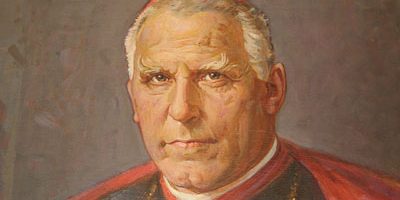
Blessed Clemens August von Galen
Dear Friends,
On 3 August 1941, when the Third Reich was at the height of its power, Bishop Clemens August von Galen fearlessly spoke out from the pulpit of his cathedral in Münster, publicly condemning the Nazi dictatorship’s monstrous plan to rid society of “unproductive lives,” including those of handicapped children, elderly people with disabilities and the mentally ill. “At this time, defenseless and innocent people are being killed, barbarously killed: people of other races and with different origins are also being eliminated. We are faced with an unequalled homicidal insanity. I can no longer belong to the same people as these murderers who in their pride, are trampling our lives underfoot!” This Pastor who risked his life with his courageous public words was beatified on 9 October 2005.
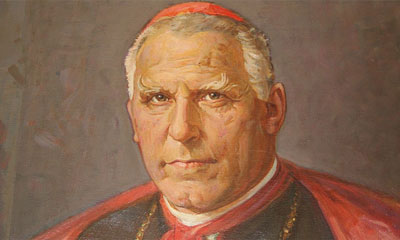 Clemens August was born on 16 March 1878, at Dinklage Castle in the diocese of Münster in Westphalia (central-western Germany). He was the eleventh of the thirteen children of Count Ferdinand Heribert von Galen and his wife Elisabeth. Life in Dinklage was rough: there was no heating or running water. But his austere upbringing was illuminated by the family’s ardent Catholic faith. They attended Mass every day and the countess herself taught her children the catechism; she brought them up to imitate Jesus Christ and to see their earthly life as a preparation for eternal life. Taking part in public affairs had a long tradition in this noble family; Ferdinand von Galen was a member of the Catholic “Zentrum” party in the imperial parliament for thirty years. Neither he nor his family saw this as a privilege, but rather as their responsibility: “Noblesse oblige.”
Clemens August studied with the Jesuits in Feldkirch, Austria. It was during a retreat at the Benedictine Abbey of Maria Laach in October 1897 that he heard God’s call to the priesthood. After studying theology in Innsbruck, he was ordained a priest on 28 May 1904, by the Bishop of Münster. In 1906, he was sent to Berlin, a diocese lacking in priests; he would go on to hold various parish ministries there. During the financial crisis of 1923, which ruined millions of German families, Father von Galen spared no effort in the service of his impoverished parishioners, and set up a society of mutual aid to help them obtain support. He would often help the most destitute at his own expense. But in all things, his ultimate goal was to save souls. It was this constant focus on eternal life that would become the rock from which he would fight his future battles.
At the beginning of 1929, Clemens August was called back to Münster and appointed parish priest of Saint Lambert. Noting signs of slackness among his flock, he published a pamphlet in 1932 under the title: “The plague of secularism and its manifestations.” It urged the faithful to fight against the secularization and dechristianization of society. Germany was experiencing a serious political crisis; on 30 January 1933, Adolf Hitler was appointed Chancellor of the Reich. Clemens August harbored no trust in the leader of the NSDAP (National Socialist German Workers’ Party), whose ideology and violent methods had been condemned by the German bishops. However Hitler, who at that point needed the support of the Catholics, courted their favor. On 20 July 1933, a concordat was signed between Germany and the Holy See. In signing this treaty, Pope Pius XI was attempting to maintain a space of freedom for the Catholic Church in what was becoming a totalitarian state. Von Galen approved of this strategy; however, on 3 April, during the Mass of investiture of the municipal council of Münster, before an audience that included many Nazi dignitaries, he reaffirmed the two foundations of the Christian social order: justice and fraternity.
The diocese of Münster had been vacant since January 1933. On 18 July, the cathedral chapter unanimously elected Father von Galen. In his first pastoral message, the new bishop commented on his motto, Nec laudibus, nec timore to the 1.8 million faithful in his diocese: “Neither praise nor fear of men will prevent me from transmitting the revealed Truth, from distinguishing between justice and injustice, good deeds and bad, or from giving advice and warnings whenever necessary.”
The Devil’s Deceit
Despite his imposing stature, Bishop von Galen was unassuming and warmhearted in his private life, but he radiated majesty when celebrating pontifically. He loved processions, because they offered the Church the opportunity to counter the neo-pagan mystique of Nazi demonstrations through its religious pageantry. Already in 1934, the bishop had condemned a work by Alfred Rosenberg, The Myth of the Twentieth Century, in which the ideological figurehead of the NSDAP exalted German blood as the “source of a superior humanity” to be built up through its life force. In his pastoral letter for Lent of that same year, the Bishop of Münster branded this doctrine as “deceit of the devil” and emphasized that only the Precious Blood shed by Jesus Christ on Calvary has the power to save us, because it is the Blood of God made man. The bishop repeated this offense a year later, proclaiming: “We cannot cease to profess that there is something higher than race, people and nation: the almighty and eternal Creator and Lord of peoples and nations, Whom all peoples must recognize, worship and serve, the One Who is the ultimate goal of all things.”
The Bishop of Münster’s attitude towards the persecution of the Jews was utterly unequivocal. Having denounced the glorification of the “Aryan race” to the detriment of other races as early as 1934, he refused to validate anti-Semitism in any way. As a bishop, he never missed an opportunity to emphasize that Christianity is rooted in the religion of Israel. He insisted that the duty of brotherly charity extends to all men, regardless of their race or religion. After the Crystal Night of 9 to 10 November 1938, a pogrom (a violent attack on Jews) during which the synagogue of Münster was set on fire by the police, and the city’s rabbi imprisoned, Bishop von Galen offered his help to the latter’s wife. When the rabbi was released a few days later, he decided not to intervene so as not to make the Jews’ situation even worse.
Hitler’s regime wanted to assert its monopoly on the education of young people by abolishing religious instruction, which was compulsory in all schools. The Bishop of Münster successfully opposed this abolition on the basis of Article 21 of the Concordat of 1933. In November 1936, the Delegate for Education in Oldenburg (in the north of the diocese of Münster) ordered the removal of all crosses and religious insignia from schools and public buildings. This measure gave rise to a full-scale “crusade” of prayers and petitions in favor of keeping the crosses, on the initiative of Bishop von Galen. The “Gauleiter” (prefect) of Oldenburg was ultimately forced to withdraw the planned order.
Countering Neo-Paganism
From 1933 to 1937, the Holy See protested forty-four times against violations of the Concordat. In view of the ineffectiveness of these efforts, Pope Pius XI published an encyclical written in German under the title: Mit brennender Sorge (“With burning anxiety”), condemning the deification of people and race. The encyclical was published by the Bishop of Münster in his diocesan paper; with the utmost secrecy, he had 120,000 copies printed, which represented 40 percent of those that the Church would succeed in distributing throughout Germany. On Sunday 21 March 1937, by order of the bishop, every parish priest read this text from the pulpit at High Mass. The Gestapo (political police), caught off guard, struck back with retaliatory measures. However, the encyclical was favorably received in a number of Protestant circles. Bishop von Galen then conceived the idea of forming a united front of German Christians against neo-paganism, which would be fought on broader ground: the defense of the natural rights of the human person, including the right to life, integrity and religious freedom, the right to follow one’s conscience, and the right of parents to educate their children.
At the beginning of 1939, the Nazi regime decided that the time was ripe to abolish all denominational education and all religious instruction in schools. On 26 February, in his packed cathedral, the Bishop of Münster asked all his diocesans to protest against “pagan schooling” by means of a petition. His appeal was followed by tens of thousands of people who, by putting their names to such a text, were risking their safety and their property. On 1 September 1939, Germany invaded Poland, which led to war being declared by France and Britain. Bishop von Galen, in stark contrast to the official warmongering rhetoric, instructed his diocesans to pray for their country and for peace, concluding with the plea that “all peoples be offered the security of peace in justice and freedom.”
Starting in the second half of 1940, a succession of acts of persecution against the Church took place: the opening of churches was delayed until 10 a.m. “because of the danger of air raids,” many priests were arrested and deported, monasteries were stormed and their occupants expelled. Bishop von Galen felt it his duty to speak out. After a time of inner struggle, he delivered the first of three great sermons in his cathedral on 13 July 1941, which would echo all over the world. Having condemned the expulsion of the clergy, he went on to protest against the reign of terror and arbitrary rule, demanding justice. The following Sunday, he urged his people to stand firm in the face of persecution: “Like an anvil that does not lose its strength despite the violence of the hammer blows, innocent prisoners, outcasts and exiles receive God’s grace to preserve their Christian resolve.”
On 3 August, in the church of Saint Lambert, Bishop von Galen delivered a homily condemning the mass killing of the mentally ill at the behest of the authorities—the “T4 program” underway in medical centers, that was providing for the “mercy killing” of unproductive and incurable patients. Some 70,000 people are estimated to have fallen victim to this murderous program. Bishop von Galen vocally expressed his outrage: “Here we are dealing with human beings, with our neighbors, brothers and sisters, the poor and invalids… unproductive—perhaps!… But have they, therefore, lost the right to live?… If the principle is established that unproductive human beings may be killed, then God help all those invalids who, in order to produce wealth, have given their all and sacrificed their strength of body!… then none of us can be sure of his life. We shall be at the mercy of any committee that can put a man on the list of unproductives. There will be no police protection, no court to avenge the murder and inflict punishment upon the murderer. Who can have confidence in any doctor? He has but to certify his patients as unproductive and he receives the command to kill. If this dreadful doctrine is permitted and practiced it is impossible to conjure up the degradation to which it will lead. Suspicion and distrust will be sown within the family itself. A curse on men and on the German people if we break the holy commandment ‘Thou shalt not kill’ which was given us by God on Mount Sinai with thunder and lightning, and which God our Maker imprinted on the human conscience from the beginning of time! Woe to us German people if we not only license this heinous offense but allow it to be committed with impunity!
Bland Camouflage
Alas, euthanasia did not disappear with Nazism. Nowadays, it is carried out in many countries; their laws generally include restrictions, but these are not enforced and the number of deaths by euthanasia is increasing exponentially year after year. The real nature of euthanasia, which is the act of taking a life, is camouflaged under bland expressions such as “aid in dying” or “assisted suicide.” In the name of the Catholic Church, Saint John Paul II judged as follows: “Here we are faced with one of the more alarming symptoms of the ‘culture of death,’ which is advancing above all in prosperous societies, marked by an attitude of excessive preoccupation with efficiency and which sees the growing number of elderly and disabled people as intolerable and too burdensome. These people are very often isolated by their families and by society, which are organized almost exclusively on the basis of criteria of productive efficiency, according to which a hopelessly impaired life no longer has any value… I confirm that euthanasia is a grave violation of the law of God, since it is the deliberate and morally unacceptable killing of a human person. This doctrine is based upon the natural law and upon the written word of God,” (Encyclical Evangelium vitæ, 25 March 1995, no. 65).
Bishop von Galen’s homily against euthanasia was published undercover and was widely circulated in Germany and abroad. Karol Wojtyła, the future Pope John Paul II, recalled having read it as a worker at the time. The “Lion of Münster” was severely reprimanded by Field Marshal Goering, who accused him of sabotaging the fighting spirit of the German people in the thick of the war with his diatribes and pamphlets. Hitler considered having the bishop who dared to resist him hanged. But the Minister of Propaganda, Goebbels, advised him to wait until having obtained military victory, so as not to cause unrest in Westphalia and shock among the Christian soldiers. At the end of August 1941, the Führer decided officially to halt the euthanasia program. However, in concentration camps in the east, many “incurable” patients were secretly exterminated right up until the fall of the regime.
The Value of Each Person
Only recently, the declaration Dignitas Infinita of the Dicastery for the Doctrine of the Faith, approved by Pope Francis, confirmed the Church’s judgment regarding euthanasia: longing and gain greater awareness of the precious value of each person to the whole human family. “There is a special case of human dignity violation that is quieter but is swiftly gaining ground. It is unique in how it utilizes a mistaken understanding of human dignity to turn the concept of dignity against life itself. This confusion is particularly evident today in discussions surrounding euthanasia. For example, laws permitting euthanasia or assisted suicide are sometimes called ‘death with dignity acts.’ With this, there is a widespread notion that euthanasia or assisted suicide is somehow consistent with respect for the dignity of the human person. However, in response to this, it must be strongly reiterated that suffering does not cause the sick to lose their dignity, which is intrinsically and inalienably their own. Instead, suffering can become an opportunity to strengthen the bonds of mutual belonging and gain greater awareness of the precious value of each person to the whole human family.
Certainly, the dignity of those who are critically or terminally ill calls for all suitable and necessary efforts to alleviate their suffering through appropriate palliative care and by avoiding aggressive treatments or disproportionate medical procedures. This approach corresponds with the ‘enduring responsibility to appreciate the needs of the sick person: care needs, pain relief, and affective and spiritual needs.’ However, an effort of this nature is entirely different from—and is indeed contrary to—a decision to end one’s own life or that of another person who is burdened by suffering. Even in its sorrowful state, human life carries a dignity that must always be upheld, that can never be lost, and that calls for unconditional respect” (Dignitas Infinita Declaration, 2 April 2024, nos. 51–52).
The war began to turn to Germany’s disadvantage from 1942 onwards, and Allied bombing raids on the country increased in frequency. The bishop did all he could to mitigate the horrors of war for the civilian population. He warned his flock not to yield to the thirst for revenge that was being stirred up by propaganda. On 4 July 1943, during a Marian pilgrimage to Telgte, he declared: “It is my sacred duty to proclaim Christ’s commandment that we must renounce hatred and vengeance… Is it really any consolation to a German mother whose child has been killed in an air raid if we say to her: ‘Well, we will soon kill the child of an English mother?’ No, the announcement of such revenge would not be a consolation; such an attitude would be neither Christian nor German.” On 1 February 1944, in his Lenten pastoral letter, the Bishop of Münster pointed out that the root cause of current disasters lies in modern man’s rejection of God’s authority. He concluded with this impassioned plea: “German people, take heed! Listen to the voice of God!” From October 1943 to October 1944, a series of air raids destroyed the city of Münster, including the cathedral; devastated by death or exile, its population fell from 150,000 to 25,000. Bishop von Galen, having narrowly escaped death during the bombing of his episcopal palace, took refuge in the countryside; on 31 March 1945, he witnessed the victorious entry of the Anglo-American troops. From then on, the bishop became the father of the countless poor and destitute left without housing or work. He took their defense against the Allied occupation forces, who pretexted the German’s “collective responsibility” to justify leaving the population defenseless against looting and famine.
Hopes for a Better Future
On 23 December 1945, Pius XII’s decision to elevate thirty-two prelates to the rank of cardinal, including Clemens August von Galen, was made public. With this, the Pope wished to pay tribute to the most courageous voice of the German episcopate under National Socialism; by promoting three Germans, the Holy Father also intended to make clear—as he himself publicly stated—that the German people as a whole could not be held responsible for the atrocities of the Second World War. After a grueling seven-day train journey, the Bishop of Münster received the cardinal’s hat on 21 February 1946, in Rome. American Cardinal Spellman provided the three German cardinals with an American military aircraft to fly them home.
On 16 March, Cardinal von Galen made his entrance into the ruins of Münster, surrounded by a huge crowd of 50,000 people who viewed him as a reason to hope for a better future. He expressed his regret at not having been deemed worthy of martyrdom; the fact that he was not arrested by the Gestapo was due to the love and loyalty of his diocesan flock: “You were behind me, and those in power knew that the people and the bishop of the diocese of Münster were bound by an inseparable unity, and that if they struck the bishop, it was the whole people which would consider itself struck. That is what strengthened me inwardly and gave me confidence.” This would be the last public act of the “Lion of Münster.” On the following day, he was diagnosed with a perforated intestine which led to his death on 22 March 1946.
On 9 October 2005, at the end of von Galen’s beatification ceremony, Pope Benedict XVI declared: “For this very reason, the message of Blessed von Galen is ever timely:faith cannot be reduced to a private sentiment or indeed, be hidden when it is inconvenient; it also implies consistency and a witness even in the public arena for the sake of human beings, justice and truth.”
Through the intercession of Mary, Mother of the Living, and of Blessed Clemens August, let us ask God, for ourselves and for all the pastors of the Church, for the courage to yield neither to praise nor to fear of men in the witness of our Christian life. Thus, will we be able to spread the Gospel of Life throughout the world, to the glory of God and for the salvation of souls.